
I came off the trail at Camel's Back Park on a Tuesday in April, drove the eleven minutes home, and then sat in my own driveway with the engine off because my knees did not want to unfold. No pop. No swelling. No fall on the rocks. Just that full, stiff, packed-with-wet-sand feeling that shows up about twenty minutes after I stop moving and stays until I go to bed. I am 57 years old. I hike the Boise foothills three or four times a week, usually three to four miles with some climbing, and my knees have been filing complaints since 2023.
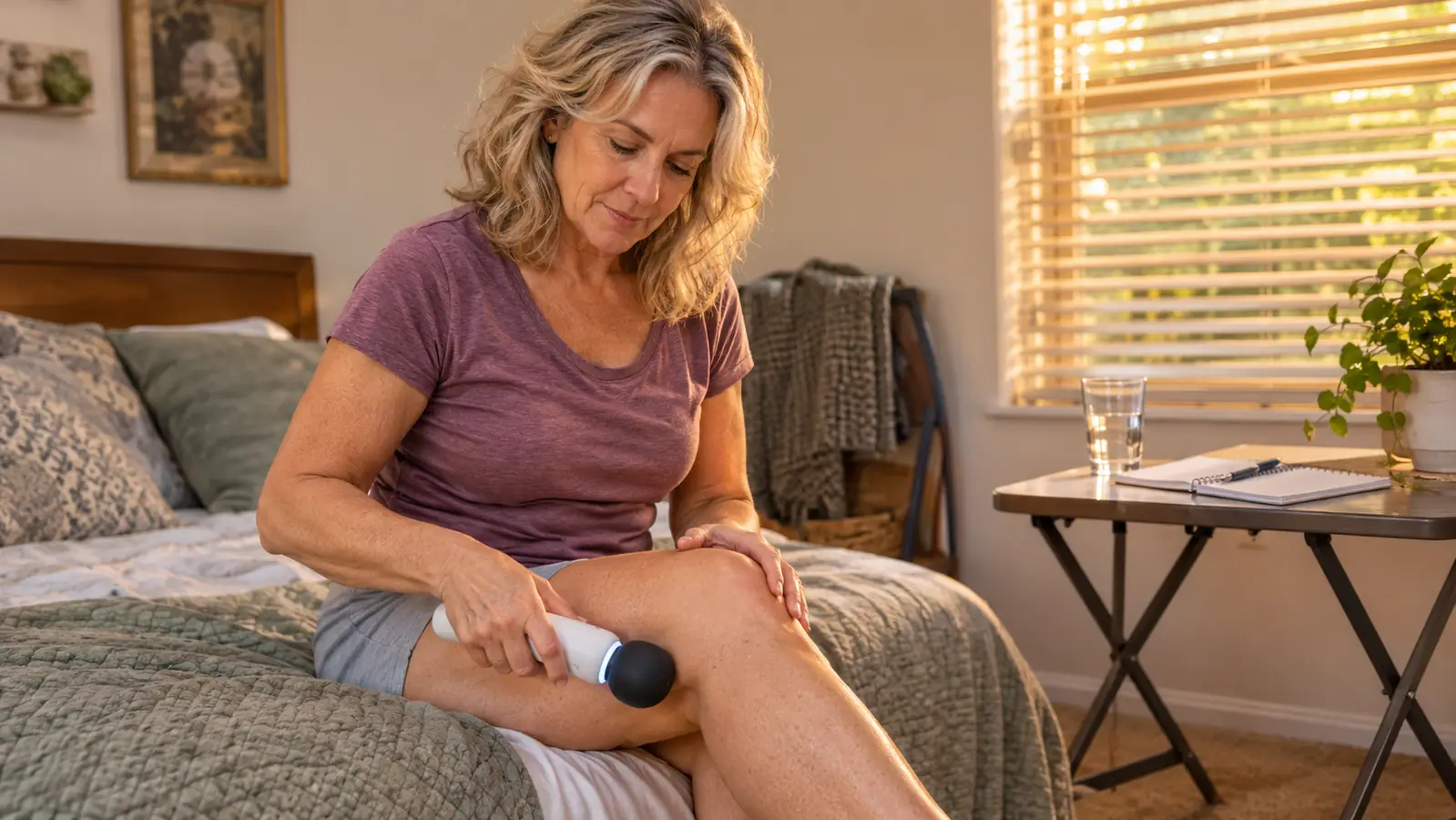
That is how the Lifepro Lumicure wand ended up on a folding table in my spare bedroom. I am Paula Westerkamp, a retired dental hygienist, and I am not a fast buyer. I read the manual twice before I turned the thing on. I want to be clear about what this is and what it is not. It is a handheld light device I use at home as part of an evening routine, and it is not a treatment for anything. My dermatologist said it was fine to try. I would tell you to have that same conversation with your own doctor before you start, particularly if you take a medication that makes you sensitive to light, if you are pregnant, or if you have a history of skin cancer.
The Device That Lives on My Folding Table
One button, three wavelengths of red and near-infrared light, six hours of battery, and a wrist strap so it does not end up on the floor at nine at night. This is the Lifepro Lumicure, the thing I reach for after every foothills hike.
Amazon Check Today's Price on Amazon →Here is the plain description, because I wish someone had given it to me before I bought one. The Lifepro Lumicure is a wand, nine inches long and six and a third ounces, with three wavelengths of red and near-infrared light and exactly one button. You touch the button, it comes on. You touch it again, it goes off. That is the entire interface. No app, no screen, no menu to learn. The battery runs about six hours between charges, which for me works out to something like three weeks of short nightly sessions.
Two small things I did not expect to care about. There is a wrist strap, and I use it every single time, because a six-ounce wand that lands on a hardwood floor after a long day is a bad ending to a decent evening. And there is a zippered case, which sounds like filler until you have spent twenty minutes looking for a device you set down somewhere in a house with two people in it. Mine goes back in the case. Every time.
I chose a wand over a panel for one unglamorous reason: my knees are not the only thing that gets stiff. After a long hike my lower back and the outside of my hip join in. A panel is wonderful if you are lying on a bed and staying there. A wand you can move. I can sit on the edge of the bed, work the front of one knee, then the side, then reach behind and get the spot above the calf, all without standing up again.
My Five-Step Routine After a Hike
Step 1: Give Yourself Twenty Minutes Before You Start
The first thing I did wrong was doing it the second I walked in the door, still in my hiking clothes, still sweating. It was not harmful, it was just useless. My knees were still hot and buzzing from the downhill, and I could not tell whether anything I felt was the light or the hike. Now I come in, take my shoes off at the mat, drink a full glass of water, and put my legs up on the ottoman for a while. Dan usually comes through with the mail and tells me about whatever the neighbor is doing to his fence.
Twenty minutes is not a rule handed down from anyone. It is just the point where my legs have stopped throbbing and I can actually feel what I am doing. If you try this, pick your own number. The useful part is being consistent about it, not the specific minutes.
If your hike was long or hot, this is also when I get ahead of the hydration problem. I am 57 and I do not bounce back from a dry four-mile climb the way I did at 40. Water first, then the ottoman, then the wand. Doing it in that order is the difference between a routine I keep and a routine I abandon by the second week.
Step 2: Put the Light on the Joint, Not Above It
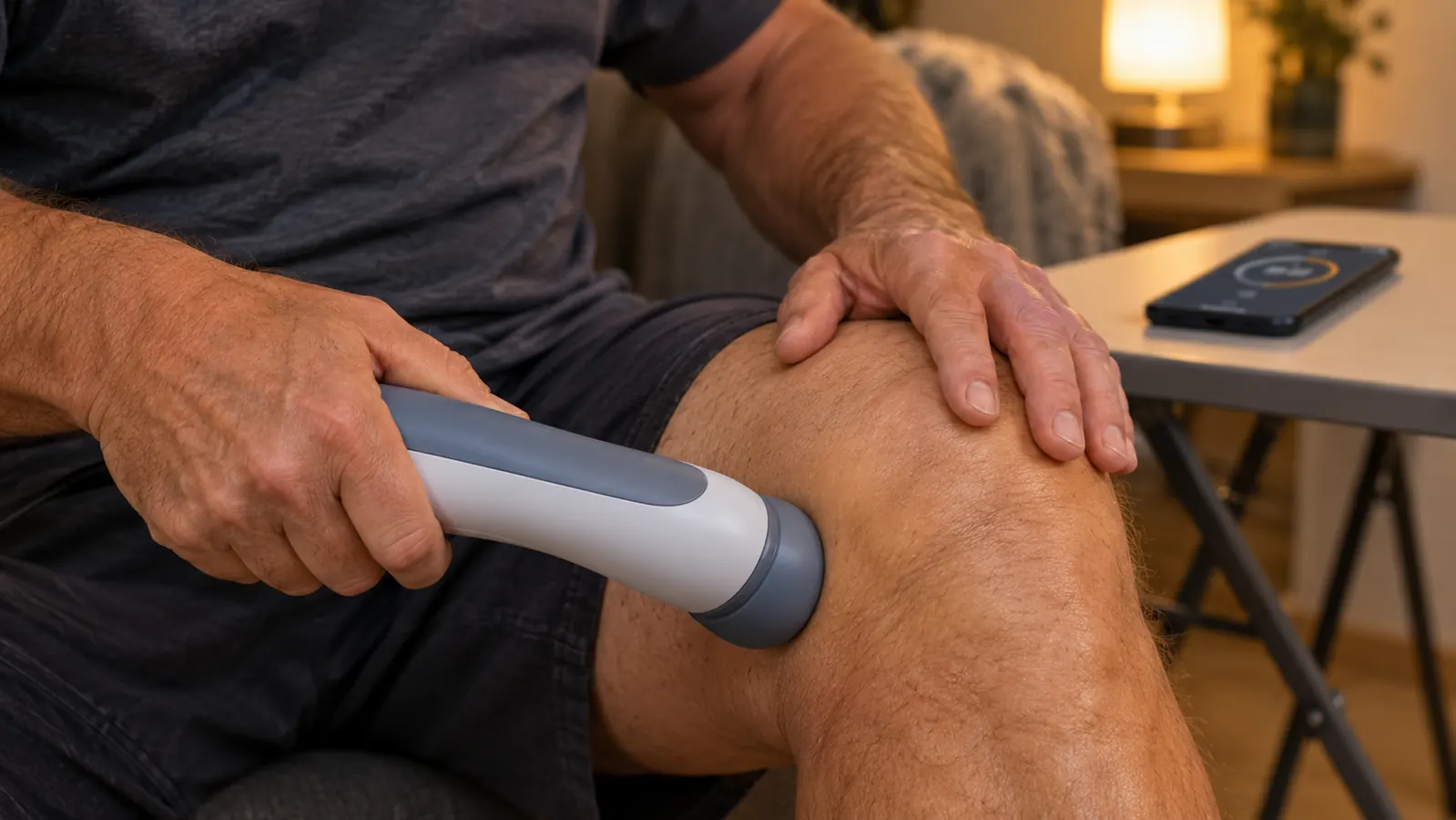
The wand head is flat and wide enough to sit against the curve of a knee without me pressing. That is the whole trick, and I learned it from a physical therapist's video, not from the manual. You rest it on the skin. You do not dig it in. I start on the front of the knee, just below the kneecap, and hold it still. Then I move to the inner side, then the outer side. On a bad week I flip over and get the back of the knee, but gently, because that area is fussy.
One practical note that the manual does say and that I would have ignored: it is not water resistant. Do not take it in the shower, do not set it on the counter next to the sink where the spray gets it, and dry your hands before you pick it up. Mine lives in the zippered case in the drawer of the folding table when I am not using it, which is also the only reason I have never lost it.
Step 3: Time It on Your Phone, Not by Feel
There is one button on this device and no timer that I have found, so the timing is entirely on me. I set a timer on my phone for eight minutes per spot and I put the phone face down where I cannot watch the clock. Eight minutes is long enough that I get bored and short enough that I actually do it. The manual has its own guidance and you should follow that over anything I say.
I will tell you where I slipped, because it is a common slip. In the beginning I was doing fifteen and twenty minutes, because more felt like it had to be better. It was not better. It was just longer, and I started skipping nights because a twenty-minute session felt like a chore. Four months in, I do eight to ten minutes, five nights a week, and I have missed about eleven nights total. I know the number because I write it down.
Step 4: Work Above and Below the Knee, Not Just the Knee
This is the step that made the biggest difference for me and it has nothing to do with the light. The quadriceps above the knee and the calf below it are doing the work on a climb, and they are the parts that feel like rope the day after. So I run the wand up the front of the thigh for a few minutes, then down the outside of the calf. The listing describes it for body and face, and I have used it on my forearm after a morning of gardening, but my knees are the reason it stays on the table.
I do not press. I do not massage with it. A wand is a light, not a roller, and every time I have gotten ambitious and pushed hard on a sore spot I have regretted it the next morning.
Dan borrows it now and then for his shoulder, which he hurt moving a bookshelf and has been complaining about ever since. He does about four minutes and hands it back. I mention it only because it tells you something about the device. It is small enough and simple enough that a second person in the house will pick it up without being taught. There is nothing to teach.
Step 5: Make It the Last Thing, and Write It Down
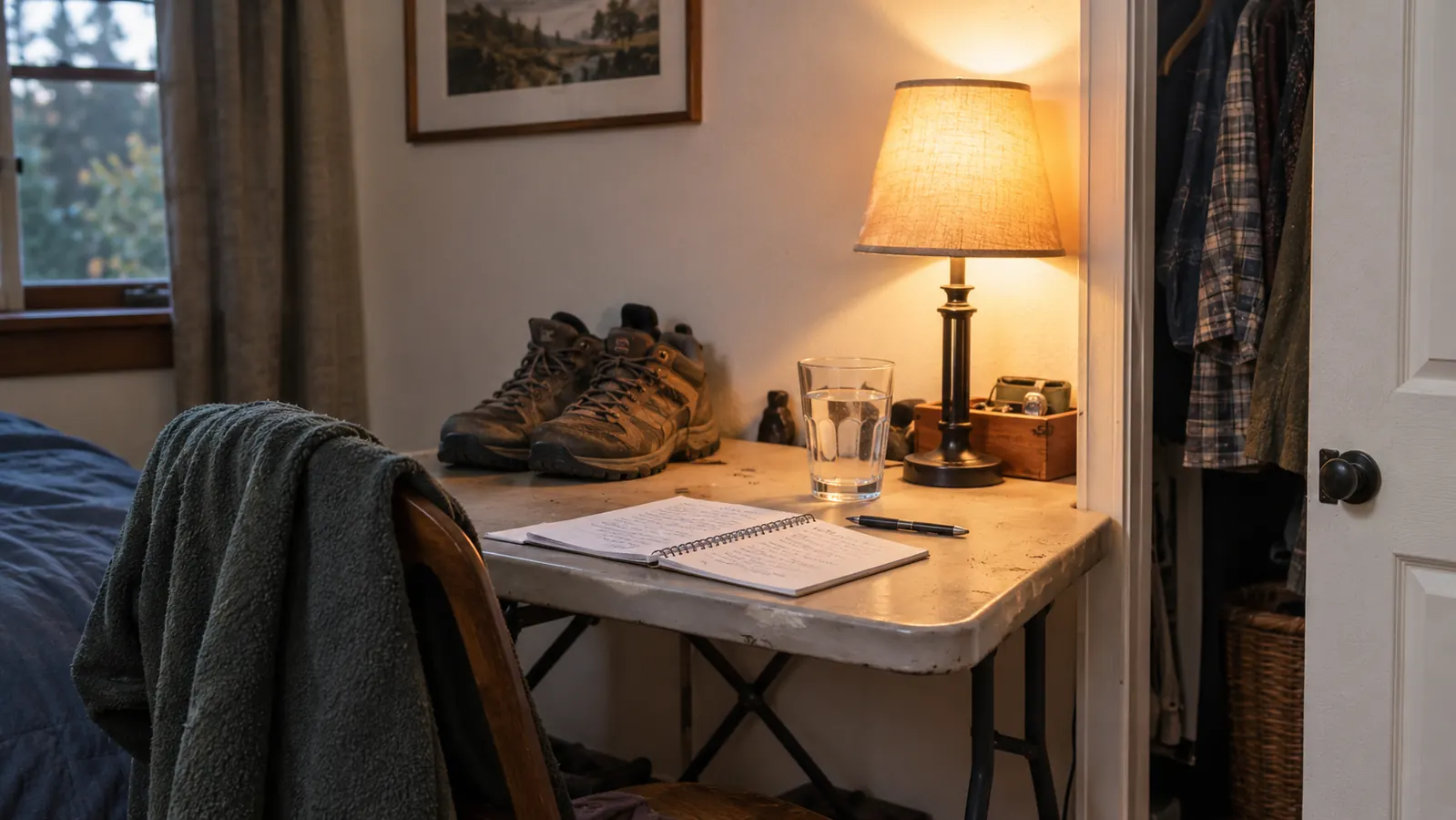
My sessions happen in the spare bedroom, on the folding table by the closet, usually around nine at night, after the dishes. It is the last thing I do before I brush my teeth, which means it is attached to a habit I already have and I do not have to remember it separately. I put on the eye protection I keep in that drawer, because I am not pointing a light device anywhere near my face without it, and I sit on the edge of the bed with one foot flat and one leg out.
The notebook is the part I would push hardest if you asked me for advice. Every night I write the date, how far I hiked that day, and one word for how the knees feel: fine, stiff, or loud. Four months of that is worth more than any review, mine included, because it is about my knees and not somebody else's. It also keeps me honest. On the nights I skip, the blank line is sitting right there staring at me.
Eight to ten minutes, five nights a week, in the spare bedroom after the dishes. The boring version is the version that actually happens.
What Else Helps
I would be lying if I told you the wand is the reason my knees feel better on the stairs. It is one part of a routine, and probably not the biggest part. The hiking shoes I replaced in May helped more than anything else on this list. The pair I had been wearing had close to five hundred miles on them and the foam had gone flat, and I did not notice until I put on a new pair and came down the same trail without the usual complaint.
The second thing is that I stopped doing the steep downhill two days in a row. There is a particular trail in the foothills with a long set of switchbacks that I love and that hates me. Now I do it once a week and I do the flatter loop the day after. That single scheduling change did more than any device. If you take one thing from this article, take that one.
Third, and this is the one people skip: I do a short set of leg extensions and calf raises three times a week, standing at the kitchen counter while the coffee brews. Nothing heroic. Ten reps, one leg at a time. The wand is what I do afterward, and I think of it as the part that makes me sit still for ten minutes, which is also useful. If your knees are genuinely painful, swollen, or giving way, that is a doctor conversation and not a gadget conversation. Please have it.
Last, a word on expectations, because I was unrealistic. Nothing about this is dramatic. There is a warm feeling under the wand, and that is about it. If you are looking for a moment where something visibly changes, you will be disappointed by week two and you will stop. The only thing I noticed was that the evenings I went through the routine were the evenings I also sat down and rested, and I suspect that combination is the honest explanation.
If Your Knees Talk to You After the Foothills
Six and a third ounces, one button, six hours of battery, and a zippered case so it lives in one place instead of the bottom of a drawer. Same device I use five nights a week.
Amazon Check Today's Price on Amazon →