
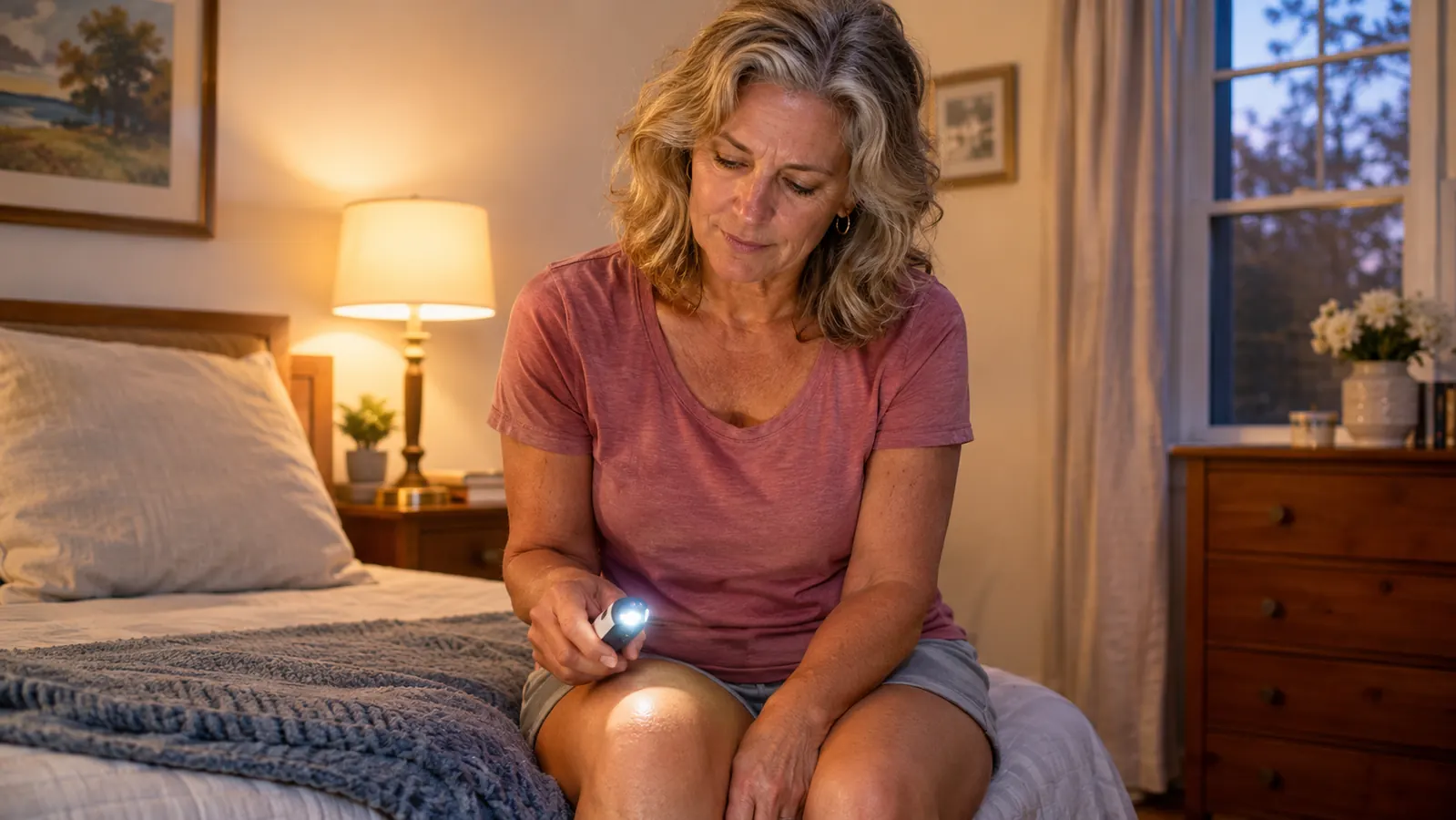
I bought the Lifepro Lumicure in March because I could not face one more device with an app. I am 57, I live in Boise, and my knees have opinions about the foothills. What I wanted was something small I could hold over a knee for ten minutes after dinner with the news on. The Lumicure is a handheld wand with three wavelengths of light, one button, a wrist strap and a zippered case. That is the whole thing. No pairing screen, no account, nothing that needs updating before I can use it. I have used it most evenings since, and I have also sat in front of a friend's full-size panel enough times to know how the two compare.
So here is the short answer. The Lumicure is for one spot at a time, and for people who will actually pick up a small thing and use it. A full-size LED panel is for covering a whole back or chest in one sitting, and for people who will leave it set up in a room. I do not think one is better than the other. They answer different questions. If your question is can I do this while holding a cup of tea in my other hand, the wand wins. If your question is can I cover my whole back before bed without moving a device around for twenty minutes, the panel wins.
| Lifepro Lumicure | Full-size LED panel | |
|---|---|---|
| Coverage area | One small head, so one knee, one shoulder or one side of the face per session | A large panel covers a back or chest in a single sitting |
| Portability | 6.35 ounces, and it travels in the zippered case it ships with | Stays where you put it, because moving it means moving the stand |
| Hands-free use | You hold it and move it yourself | You sit in front of it and read |
| Getting started | One button. Touch it and the light is on | Assembly and a permanent spot in a room |
| Storage | Goes in a drawer with the strap and the manual | Stays out, or gets put away with real effort |
| Face and jawline | Easy to hold still along the jaw for a few minutes | Workable, but you sit closer and keep your eyes shut |
| Water resistance | Not water resistant | Not something I would take near water either |
| Best for | Knees, hands, jaw, one spot at a time | Back, chest, both legs at once |
What the Lumicure Actually Is
The Lifepro listing gives the dimensions as 9.06 by 5.91 by 1.97 inches and the weight as 6.35 ounces. In my hand it is lighter than a filled water bottle, which matters more than I expected, because a device you notice holding is a device you stop holding. It is shaped as a massage wand, and the target use on the listing is body and face. Mine lives in the zippered case with the wrist strap and the user manual, and it comes out onto the folding table in the spare bedroom most evenings.
Before I bought it I spent most of the previous winter with a plug-in desk lamp on a flexible neck. A friend swore by hers and I believed her. The problem was that it lit the whole corner of the room whether I was sitting in it or not. To use it the way she described, I had to wheel a chair into position, turn off the overhead light, and sit at an angle so the head landed on the outside of my left knee. I did that four times in three weeks. The fifth time I looked at the chair, went and folded laundry instead, and did not think about the lamp again for a month. That is not a knock on the lamp. It is an accurate description of me.
What it is not matters just as much. It is not water resistant, so it does not go near the bathroom sink and it does not come into the shower with me. The listing puts battery life at six hours on average, and my sessions are short enough that I have never run it down. It is not a panel and it does not pretend to be. One button, touch it, and the light comes on. That is the entire interface, and after a year of appliances that want my Wi-Fi password, I found that restful.
Where Lifepro Lumicure Wins
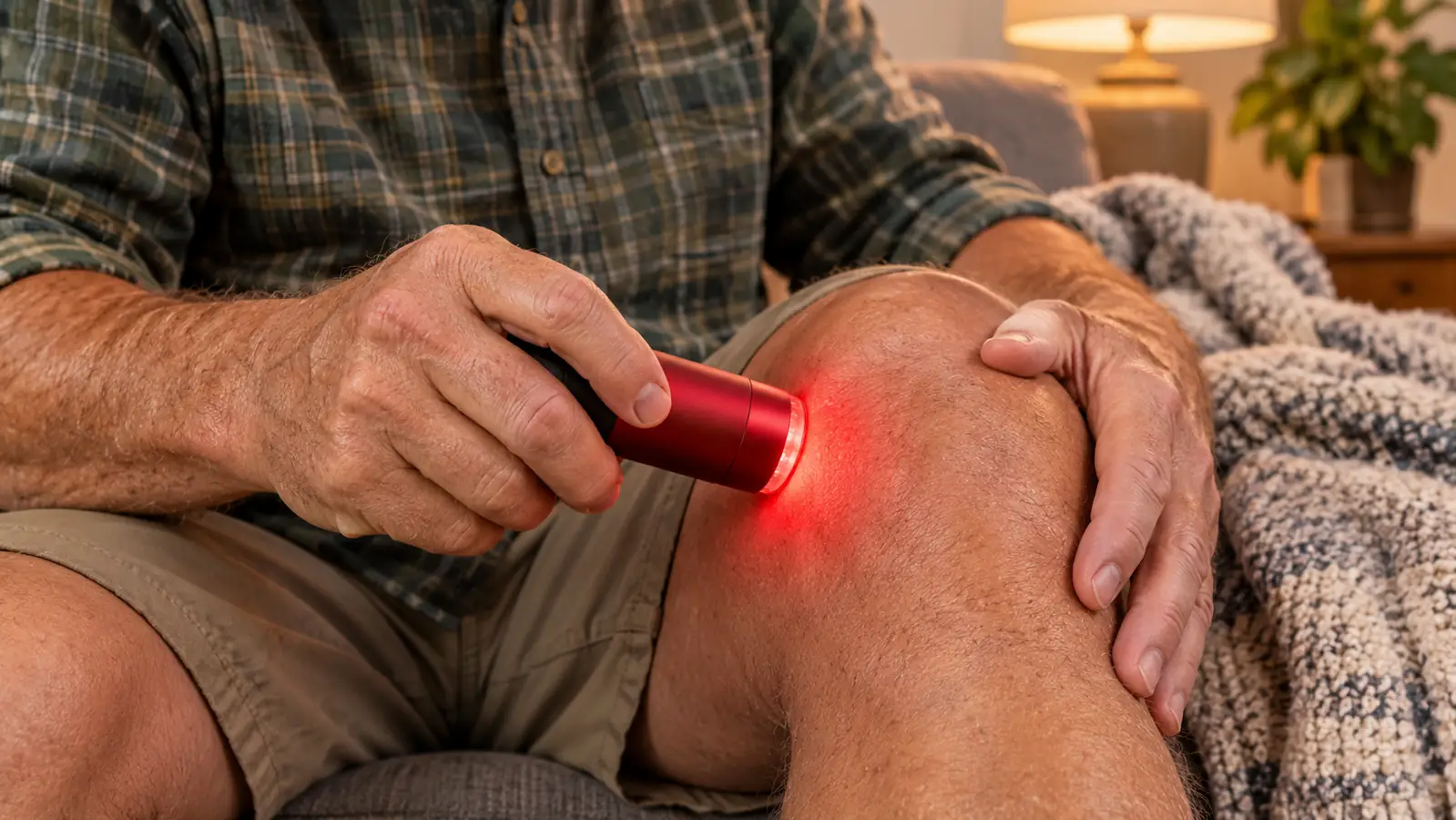
The first win is aim. A panel lights a rectangle and you arrange your body inside it. The Lumicure goes where my hand goes, so I can work along the outside of a knee, then the inside, then up the front of the thigh, and all I am moving is my wrist. For a jaw, a wrist, the top of a foot or one shoulder, that precision is the difference between a session that fits the spot and a session that mostly misses it.
A concrete example, because I like numbers. The joint line on my right knee is about a hand's width across. The head of the wand is close to that. So one pass up the outside covers the spot I came for, and I do six passes, three up and three back, roughly ninety seconds each, which is where my nine minutes comes from. In front of my friend's panel, plenty of the light landed on my thigh above the knee and my shin below it, and less on the four inches I had actually sat down for. That is not a flaw in the panel. It is just a different shape of tool.
The second win is that it disappears into a drawer. The case, the strap, the six and a bit ounces, all of it means I do not have to give it real estate in the house. Dan, my husband, picked it up for his shoulder one night without asking me how it worked, which is the highest compliment a device can get in this house. Anything with a stand and a permanent spot gets used less here, because a permanent spot becomes furniture, and furniture gets ignored.
Where the Full-Size Panel Wins
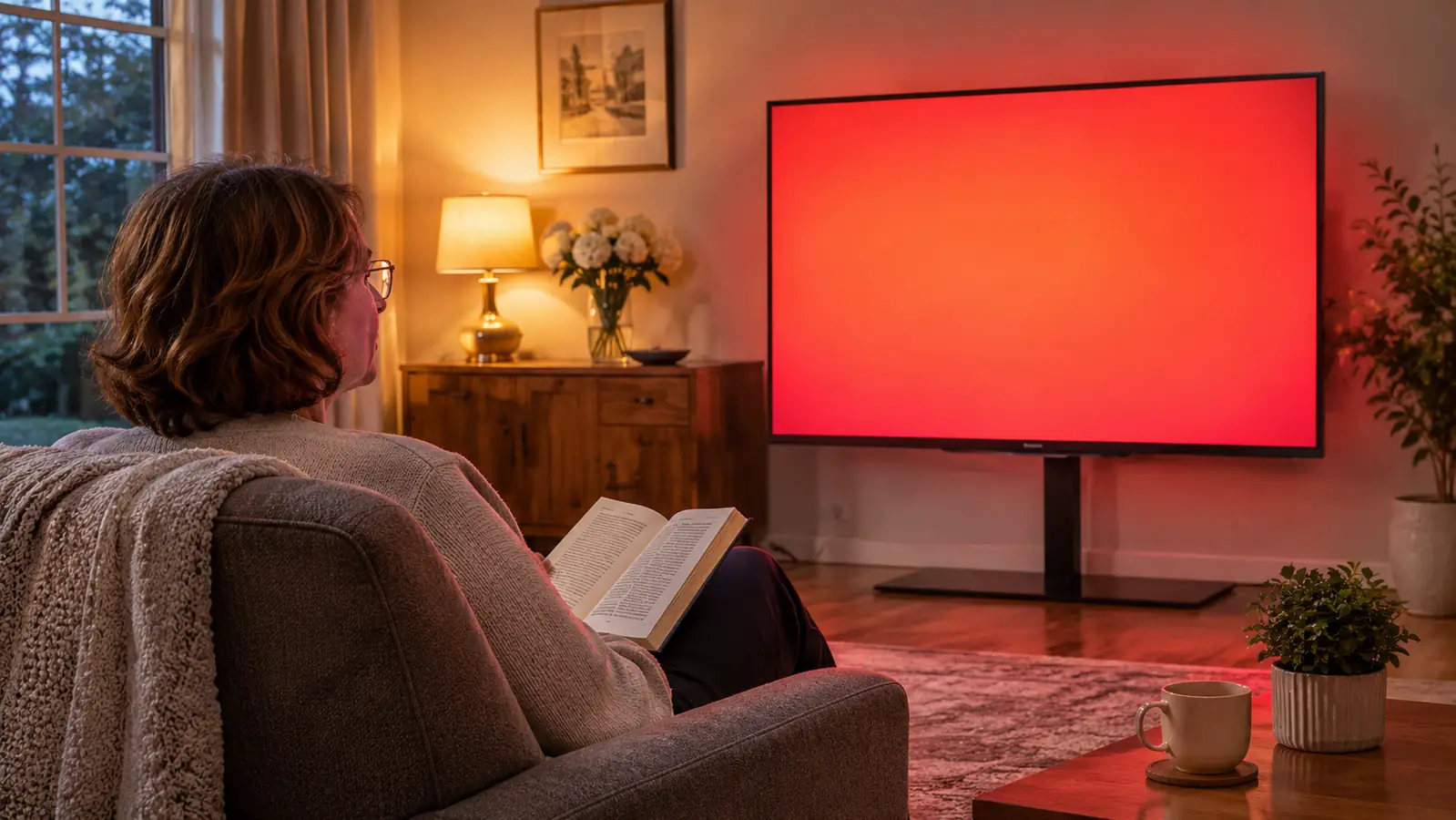
The panel wins on area, and I want to be fair about that. If the goal is a whole back, a chest, or both legs at once, a panel does in one sitting what the wand does in five passes. When my friend set hers up and I sat in front of it, I understood the appeal in about ninety seconds. You sit, you read, you stand up. Nothing in your arm gets tired.
The first time I sat in front of hers was a Sunday in February. She had it on a stand in the corner of her living room, angled toward a recliner, and she handed me a magazine and told me twenty minutes. I want to be honest about what happened, which is that I read four pages of that magazine and forgot I was doing anything at all. That is a genuine advantage and I am not going to pretend otherwise. When I stood up I had not once thought about my arm, my wrist, or whether the light was pointed where I meant it.
The panel also wins on the evenings when you do not want to be doing anything. A wand session is a small active task. You hold it, you move it, you keep track. A panel session is closer to sitting in a warm chair. If your days are already full and the only way you will keep a routine is to make it the easiest thing in the room, that matters more than the size of the head.
If Your Plan Is One Knee at a Time, Start With This
The Lumicure is a one button handheld wand with three wavelengths, a wrist strap and a zippered case. It fits a drawer, it fits a knee, and it does not need an app.
Amazon Check Today's Price on Amazon →Nine minutes a knee, most evenings. The first change I noticed was not in my knee. It was that I had stopped putting the session off.
How a Session Actually Goes in My House
The spare bedroom has a folding table by the closet, and that is where the case lives. I start after dinner, usually around eight, with the phone face up next to me for the timer. Eye protection goes on before the button, every time, and I keep my eyes closed behind it because that is the habit I built and I am not going to tinker with it now. Then it is one knee, slow passes, about nine minutes, and then the other if the first one talked me into it.
The first week I got it wrong twice. I sat on the bed instead of the chair, which put my knee lower than the table and made me hold the wand at an awkward angle, and I quit after four minutes both nights. Moving to the chair fixed it. Now the routine is: case out of the closet, strap on, eye protection on, timer set for nine, one knee, then the other if I have it in me, then the case back in the closet. The whole thing including putting it away is under twenty-five minutes, and eleven of those are light.
The wrist strap is more useful than I expected. I loop it on and it stops me from doing the thing I do with every small device, which is set it down mid-session to deal with something and lose the thread. Light pressure against the skin, keep moving, do not park in one spot. The listing describes the benefits as stress relief and muscle therapy, and I will tell you only what I can honestly say, which is that the nine minutes are quiet and the knee feels warm when I am done. Warm is not the same as fixed. I know that.
What Three Wavelengths Means in Practice
The listing says the Lumicure combines three wavelengths of light, and it does not break them into numbers on the page I read. I read the manual twice, as I do, and I am not going to pretend I can verify any of that from my kitchen. What I can tell you is what three wavelengths versus one changes about the experience, which is nothing I can see. There is no dial to choose between them. One button turns it on, and the light that comes out is the light that comes out.
This is where I would slow down if we were talking in person. Light devices are not a place to self diagnose. If you take a medication that makes you light sensitive, if you are pregnant, if you have a history of skin cancer or any photosensitivity issue, ask your doctor or dermatologist before you start, not after. My own dermatologist said it was fine for me to try, and that sentence is doing a lot of work in this article. Your situation is not mine.
What I Liked
- One button, no app, no account, nothing to pair
- 6.35 ounces, light enough to hold through a full session
- The zippered case and wrist strap mean it stores in a drawer
- Easy to aim at a jaw, a wrist, a shoulder or one knee
- Dan used it without instructions, which says something
Where It Falls Short
- One spot at a time, so a whole back takes several passes
- You hold it, so your arm does the work a panel would do
- Not water resistant, so it stays away from the sink
- I track the minutes on my phone, which is one more thing to remember
The Honest Trade-Off
The trade is area for attention. A panel gives you coverage and asks for a spot in the room. A wand gives you a drawer and asks for your hand. Both of those are real costs, and which one you feel more is not something I can guess from here. I know that I will hold something for nine minutes. I also know that I would walk past a stand in the spare room for a month and stop seeing it.
The other trade is patience. Neither device owes you a result on a schedule, and the listing's own language is careful for a reason. What I noticed over six months was not dramatic and would not make a good commercial. Some evenings my knees felt easier on the stairs. Some evenings they did not. I kept the routine because the routine itself is nine quiet minutes, and that turned out to be worth something separate from the light.
One thing I would have wanted to know before I started is how much of this is bookkeeping. I mark the sessions in a paper calendar in the kitchen, one small tick per knee per evening, because after a month I could not tell you whether I had done it four times or eleven. The ticks are not a scoreboard. They are just the only reliable record I have. When I looked back at February there were nine ticks in twenty-eight days, which is a more honest number than the one I would have given you from memory.
Who Should Buy Which
Buy the Lumicure if your list is short and specific. A knee. A shoulder. The side of a jaw. A wrist that has been typing since 1994. Buy it if you know yourself well enough to admit that a device living in a drawer beats a device living in a room you never enter. Buy it if you want to start small and find out whether you are the kind of person who keeps up a routine at all.
Buy the panel if your list is broad, or if you have a room where a stand can live and you will not mind looking at it. Buy it if holding something for ten minutes sounds like a chore you will skip by Thursday. And before either purchase, have the light sensitivity conversation with your doctor. That is not a formality. It is the part I would want a friend to hear first.
One Button, One Knee, Nine Minutes
If that sounds like the version of this routine you would actually keep, the Lifepro wand is the one I use most evenings. Check the current listing for today's price and the full spec sheet.
Amazon Check Today's Price on Amazon →