
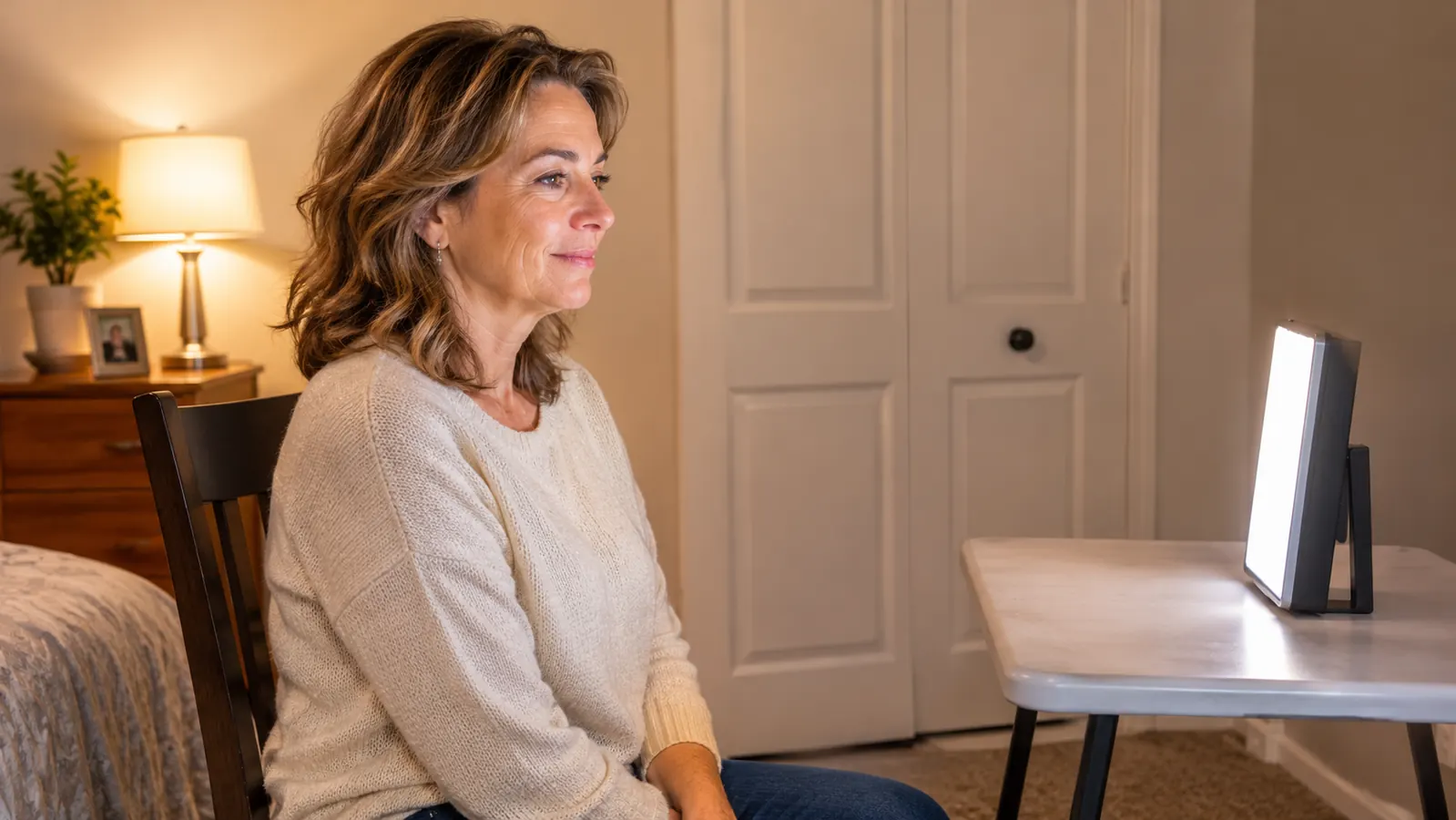
My knees started complaining around the third mile of a Boise foothills trail, and my skin started complaining about the same time, only quieter, the way skin does. I am fifty-seven and I spent thirty-one years as a dental hygienist before I retired, most of that time telling other people to look after themselves. So in the spring I cleared a corner of the spare bedroom, dragged a folding table next to the closet, and started using a Bestqool red light panel most evenings. Six months later that table is still there. That is the part that surprises me.
I did not want a clinic in my own house. I wanted something small that I would still use on a Tuesday night when I was tired. The Bestqool panel is 8.4 inches wide, 2.1 inches deep and 13.1 inches tall, and it weighs 4.8 pounds, so I can pick it up with one hand and set it back down without rearranging the room. It runs 105W through dual-chip LEDs at 660nm red and 850nm near-infrared, and the listing describes three modes. I read the manual twice before I plugged it in, which is who I am, then a third time because the section on distance mattered more than I expected.
The Quick Verdict
Small, simple, and easy to keep using, which is most of the battle with anything you do at home. Six months in, the routine is what stuck. I would buy it again, and I would read the distance page first.
Amazon Check Today's Price →A 4.8 pound panel that earned a permanent spot by the closet
It stands about a foot tall, so it fits on a folding table where a larger unit would end up living in a closet instead. If you want the short version before the long one, start with the current listing.
Amazon Check Today's Price on Amazon →How I've Used It
The routine is short and I have never once looked forward to it the way I look forward to a walk. I sit on a straight chair in the spare bedroom, put on the goggles that came in the box, prop my phone on the table where I can see the time, and sit still. Most days of the week, usually after dinner and before the news. I started at arm's length because I was nervous about my eyes and my skin, and then I read the manual properly and moved closer, which is the single change that made the panel feel like it was doing anything at all.
Three modes are listed and I tried all of them the first week. I settled on one and I have not moved off it since, because the point was to build a habit and not to build a hobby. There is no ceremony to it. I switch it on, I sit down, I get up when the phone says so. A woman who spent three decades on her feet does not need a second job at nine at night.
The goggles are not a suggestion. The manual says to wear them and I wear them, every session, even when I am only working on my knees. Dan, my husband, is sixty and borrows most things I bring home. He used it on his shoulder twice in April, decided that sitting still was not for him, and went back to his heating pad. That is a fair verdict from a man who does not sit still well.
What the Panel Actually Sends Out
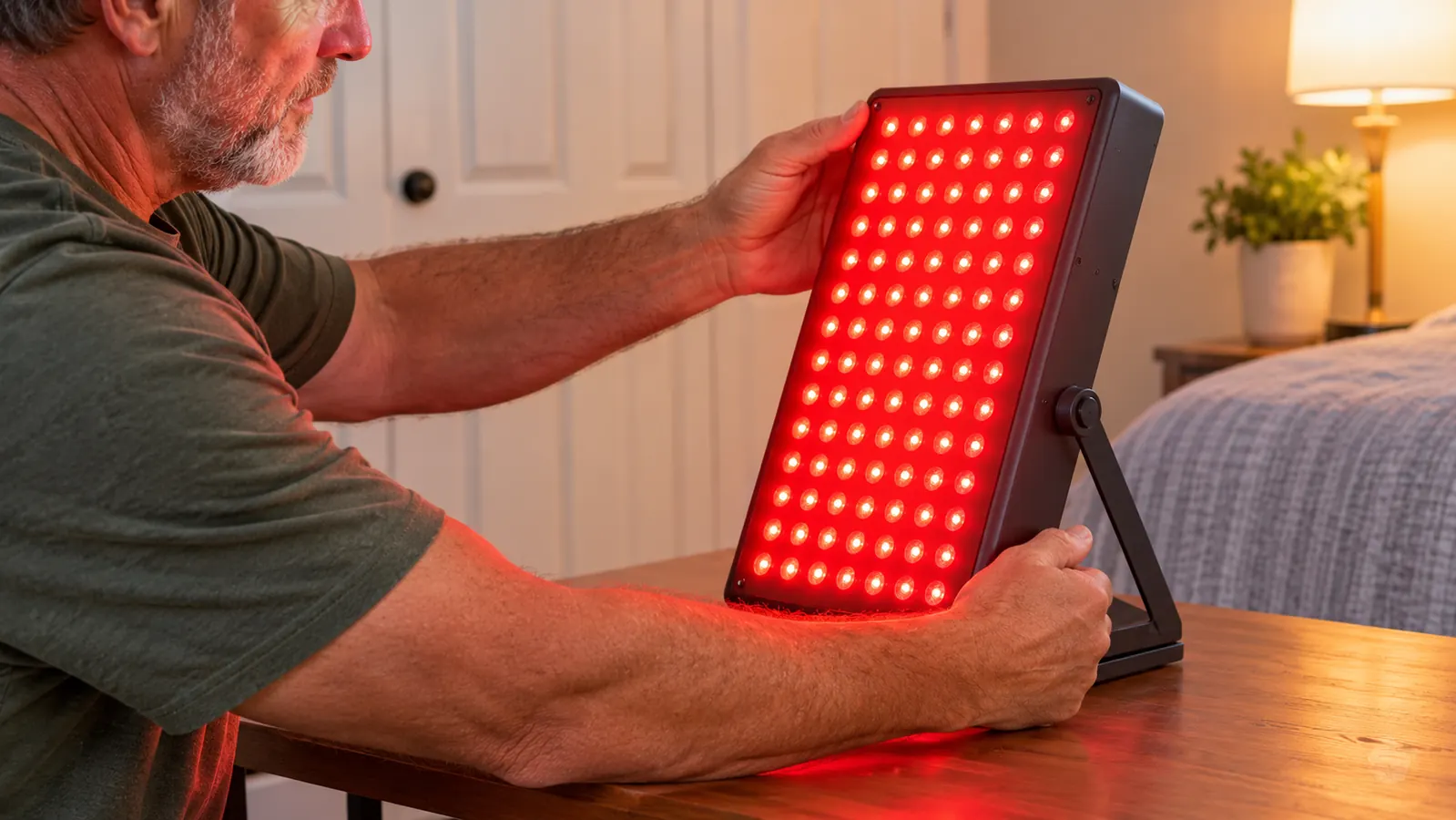
Two wavelengths come out of it. The 660nm red is the one you can see. The 850nm near-infrared is the one you cannot see, and the only reason I knew it was on the first time is that the skin on my knee felt mildly warm after a few minutes, in a way that does not build the way a heat lamp builds. I have sat under heat lamps. This is not that, and I would not call it hot.
I want to be honest about my starting point. I assumed a panel like this was an expensive night light with better marketing. I bought it because my dermatologist did not tell me not to, and because a friend in her sixties has one and likes it. That is not a scientific reason to buy anything, and I am not presenting it as one.
What it is not matters more than what it is, because the internet is loud about red light. I am not going to tell you this panel cured anything. It did not, and I would be lying if I used that word. What I can tell you is what my evenings look like now and how the stairs at the trailhead felt at the end of this hiking season compared to the last one. That is the whole of my evidence. It is one woman, one household, and no control group.
My dermatologist told me it was fine to try, and I would pass that along before anything else. If you take a medication that makes your skin light sensitive, if you are pregnant, if you have a history of skin cancer, or if you have any photosensitivity at all, ask your doctor before you buy a panel or sit in front of one. That is not a line I am pasting in because a website told me to. It is the first thing I would say to a friend at my kitchen table.
The One Number That Changed How I Sit
The listing rates the panel at 95.6 mW/cm2 at three inches. I read that line four times before it landed, because three inches is very close. My instinct was to sit across the room where it felt comfortable, and that is the one reliable way to use a small panel badly. The number is not a marketing flourish. It is a distance instruction hiding inside a specification.
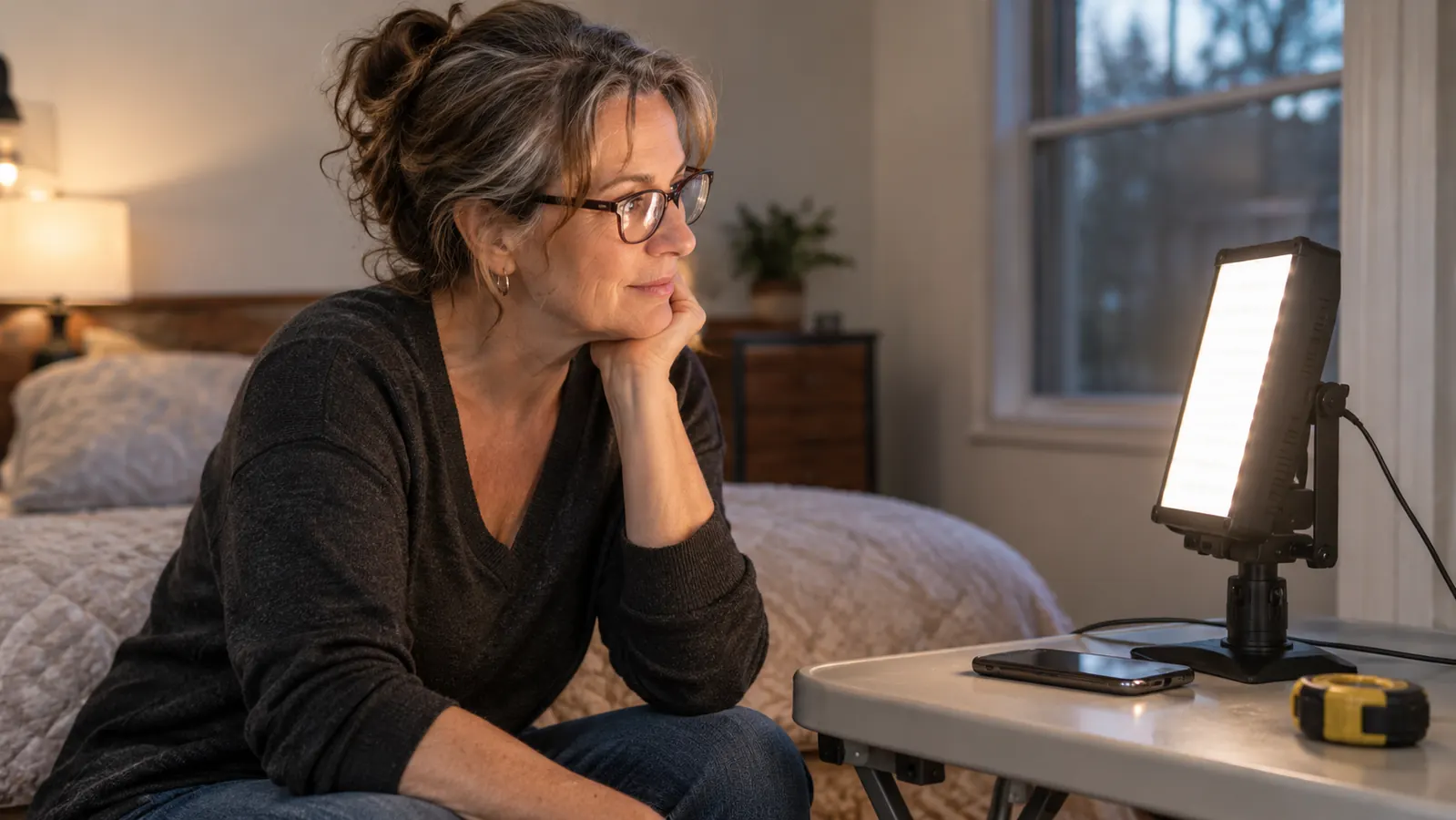
Light falls off quickly with distance, and every extra inch costs you. I got out a tape measure and looked at what three inches actually is from the side of my knee. It looks like nothing. It looks much closer than you would choose on your own. That measurement did more for my routine than any article I read before buying, and I would tell anyone to do it on day one.
The other number is 105W, which is what the whole panel draws rather than the dose that lands on any one spot. I stopped confusing those two somewhere around month two. On a panel this size it also tells you the honest truth about coverage. The useful area is small, roughly the size of a dinner plate at that distance, and if you want to cover more you move the panel and sit down again.
What Six Months Actually Looked Like
I hike the foothills from April into October. This season I noticed the stairs at the trailhead less than the year before, in the sense that I stopped thinking about them at all. My knees are still my knees. There was no morning where I woke up feeling different, and I want to be plain about that, because the stories online make it sound like a switch. It was the kind of change you only see when you look backward over a whole season.
My skin is harder to judge and I am not going to pretend otherwise. I am fifty-seven and I spent a lot of years in a dental office under hard light. I think the skin on my cheeks looks a little less tired in the evening, and I could be talking myself into that. Six months of anything plus the moisturizer I already used is a lot of moving parts for one face.
The thing I can say without hedging is that I missed it when I traveled for a week in August. Not because everything fell apart without it, but because the ten minutes of sitting still in a quiet room had become the part of my day I wanted. I came home, set my bag down, and used it before I unpacked. That is the honest measure of whether a device earns its space.
What I Compared It To Before Buying
I looked at the big panels first, the ones that stand on a base and light up a wall. They are a much bigger commitment for a habit I had not proven yet, and they need floor space in a house that does not have any to spare. I also looked at the small handheld wands. They take up nothing, and they are also the kind of thing that ends up in a drawer, because you have to hold them and my hands are busy enough.
The middle option, a panel about the size of a hardback book standing on end, is where I landed. It sits on a table, it needs no assembly, and it does not ask me to clear a wall. If I had wanted whole body coverage in one pass I would have made a different choice, and I would have had to give up the corner of the spare bedroom to do it.
I also read a good number of reviews before I bought, which is how I found pages like this one in the first place. The reviews that helped were the boring ones, from people who had used a panel for months and said something specific about how they sat and for how long. The ones that did not help were the ones where somebody's shoulder was fixed in four days. I have been alive long enough to be suspicious of four days.
The Small Things Nobody Mentions
The first is the outlet. My spare bedroom has one behind the bed, so I moved a lamp and freed it up before my first session. Do that part ahead of time. Standing there with goggles on, hunting for a place to plug in, is a silly way to start something you are trying to turn into a habit.
The second is that you have to be still. Ten minutes of sitting still is ten minutes of sitting still, and the first week I was checking the time every ninety seconds. Now I use it as the ten minutes I do not answer anyone. Dan knows not to ask me a question with the goggles on, which has been good for both of us.
The third is that moving it from your knees to your face changes the whole setup, including where the chair goes and how close you sit. I do knees first, then face, and I keep a piece of tape on the table so I do not have to think about the distance twice. If that sounds fussy, it is, and it is also why I have kept at it for six months.
What I Liked
- 4.8 pounds and 13.1 inches tall, so it lives on a folding table without taking over the room
- Dual-chip LEDs at 660nm and 850nm mean one panel covers the red and the near-infrared together
- Three modes listed, and I only ever needed one of them
- Unbox it, plug it in, put the goggles on, sit down
- Easy to move between knees, shoulder and face inside a single session
Where It Falls Short
- The useful coverage area is small, so a back or both knees means resitting
- Three inches is closer than feels natural and needs a tape measure the first week
- The goggles are necessary and they are not comfortable
- I cannot tell you it will do for you what it may have done for me
- It is dull, and dull is why half of these end up in a closet
At three inches the panel is rated 95.6 mW/cm2, and that distance is the only setting I actually adjust. I measured it with a tape measure once and I stopped guessing after that.
Who This Is For
This is for someone who wants a small panel aimed at a specific spot, knees first in my case, and who will leave it standing in a room they already walk through every evening. It suits a person who knows they will not drive to appointments three times a week but will sit down for ten minutes at home. The Bestqool panel is twelve steps from my kitchen, and that proximity is the only reason I have used it most evenings for six months.
Who Should Skip It
Skip it if you want to stand in front of something and cover your whole body in one pass. You would spend the session moving a small panel and sitting back down. Skip it if you want a schedule handed to you with a protocol attached, because what comes in the box is a device and a manual, and the rest is your own habit. And if you are looking for treatment of a diagnosed condition, talk to your doctor or dermatologist first. A panel you order online is a wellness habit, not medical care.
Measure the distance before your first session. It is the setting that matters most.
Three inches is closer than it sounds, and it is where this one is rated. If you have read this far you already know what the panel is and what it is not, so go look at the details yourself.
Amazon Check Today's Price on Amazon →