
Nobody warns you that a red light belt is boring. That is the first thing I would tell a friend across my kitchen table. There is no fanfare, no dramatic sensation, no moment where you think, well, that did something. You strap it on, you sit in a folding chair in the spare bedroom, and your phone counts down while the house settles around you. Then you do it again the next evening. And the one after that.
For the record, I am Paula Westerkamp, 57, and I retired from dental hygiene a few years back. I live in Boise, Idaho with my husband, Dan, who is 60 and who has borrowed this belt twice for his shoulder. My knees started complaining on the foothills trails two summers ago, and I wanted to do something for my skin without a bathroom counter full of bottles. My dermatologist said a red light belt was fine to try. So I bought the Comfytemp belt with my own money, I have used it most evenings since, and this is the honest version: what I like, and what I would change if I were the one designing it.
The Quick Verdict
A simple corded belt with 126 beads and two chips in each, and it is genuinely easy to keep using. The cord and the unlabeled buttons are the tradeoffs. Good for someone with a chair and an outlet, less good for travel.
Amazon Check Today's Price →This is the belt that stayed on the chair
126 lamp beads, 660nm and 850nm in every bead, 22 watts, corded, four modes and three levels. I use it on my knees and my lower back most evenings.
Amazon Check Today's Price on Amazon →How I've Used It, Night After Night
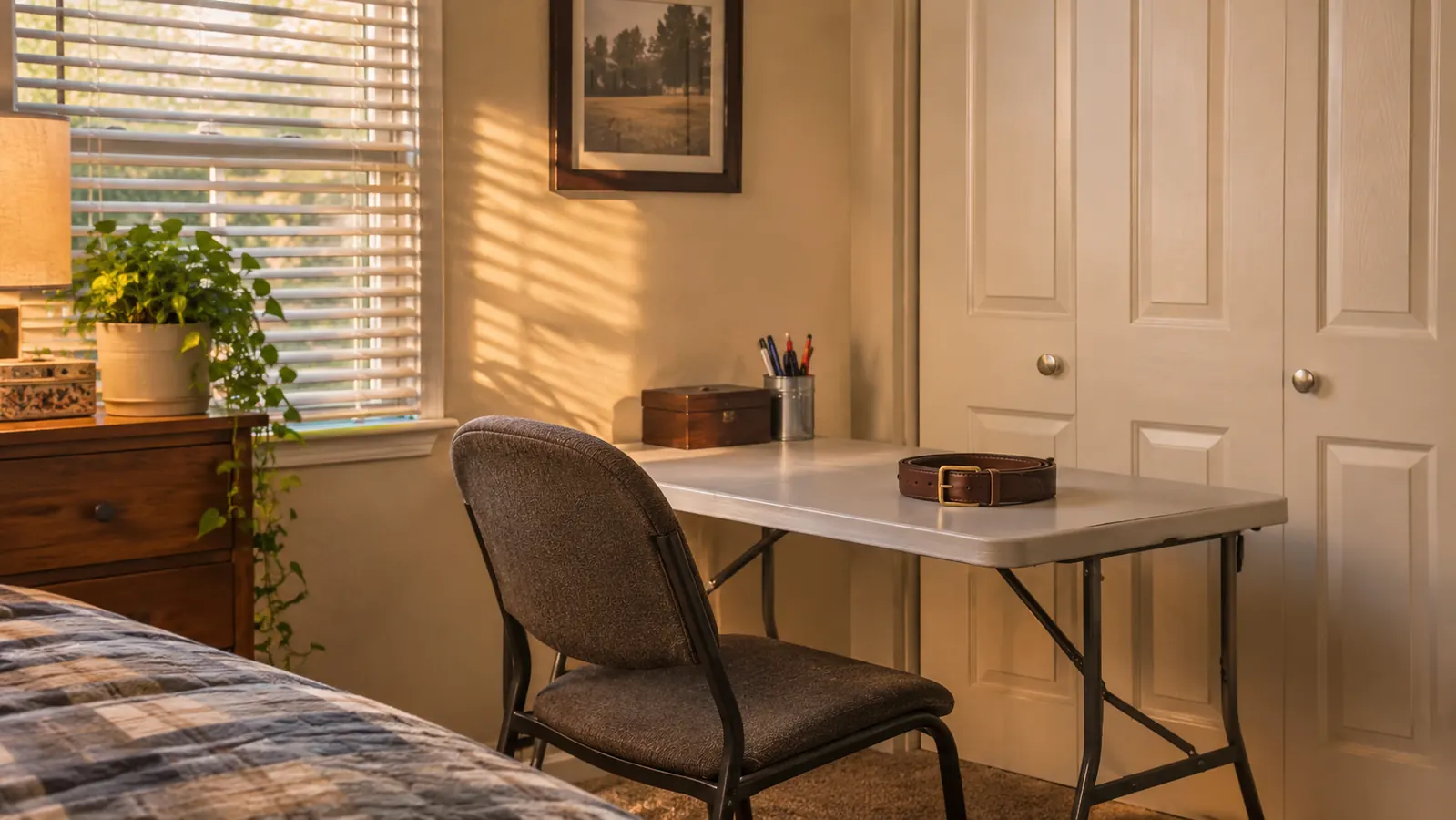
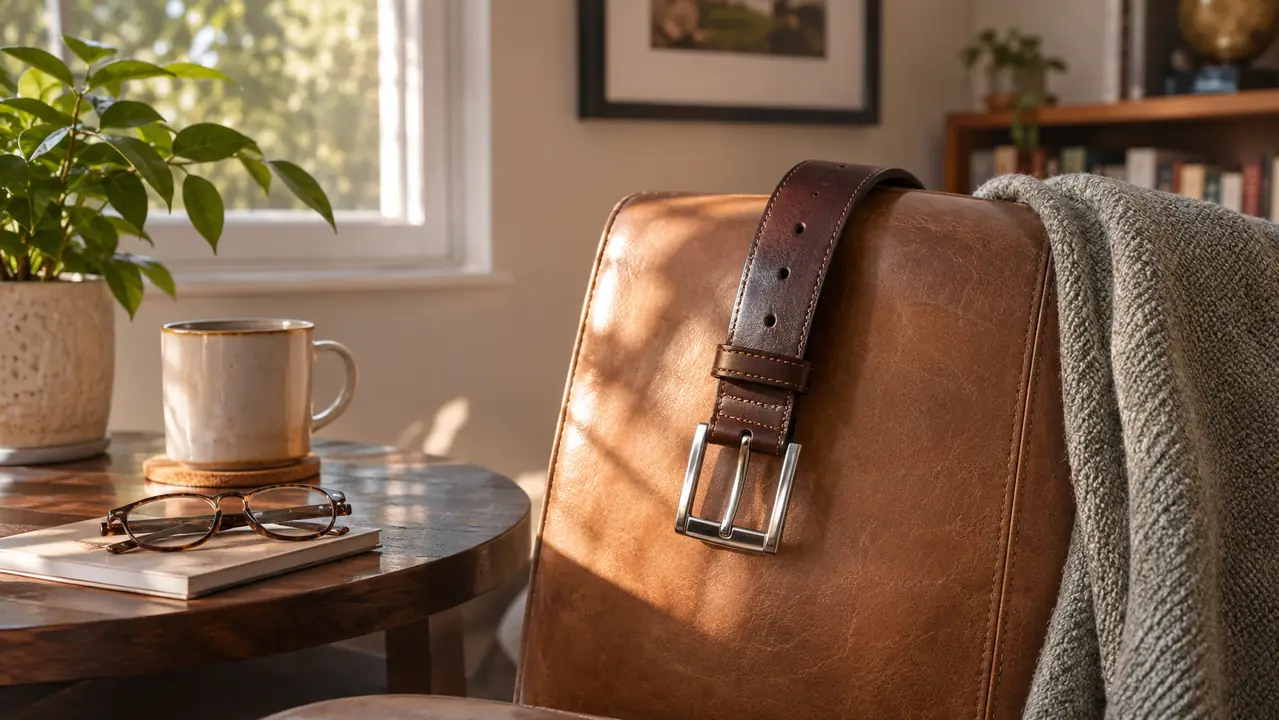
I set up in the spare bedroom of our single story house, on the folding table by the closet. The belt hangs over the back of a chair between sessions, which is the entire storage system. I use it in the evening, usually after dinner, usually after Dan has claimed the recliner in the living room and the kitchen has been wiped down.
Before this I tried two other things, and I want to be honest about why they failed, because the failure had nothing to do with the light. The first was a small handheld panel I had to hold in place with my own hand. Ten minutes is a long time to hold your arm at an angle. The second was a mat that lived rolled up behind the couch, and because it lived behind the couch, I used it four times in five months. Both are probably fine devices. Neither survived contact with how I actually live.
Being corded turned out to be less of an obstacle than I expected. My outlet is right there behind the table, so the belt lives plugged in and I never think about charging it. If your only outlet is across the room, decide now whether you are willing to move furniture, because I know myself well enough to know I would have quit after a week.
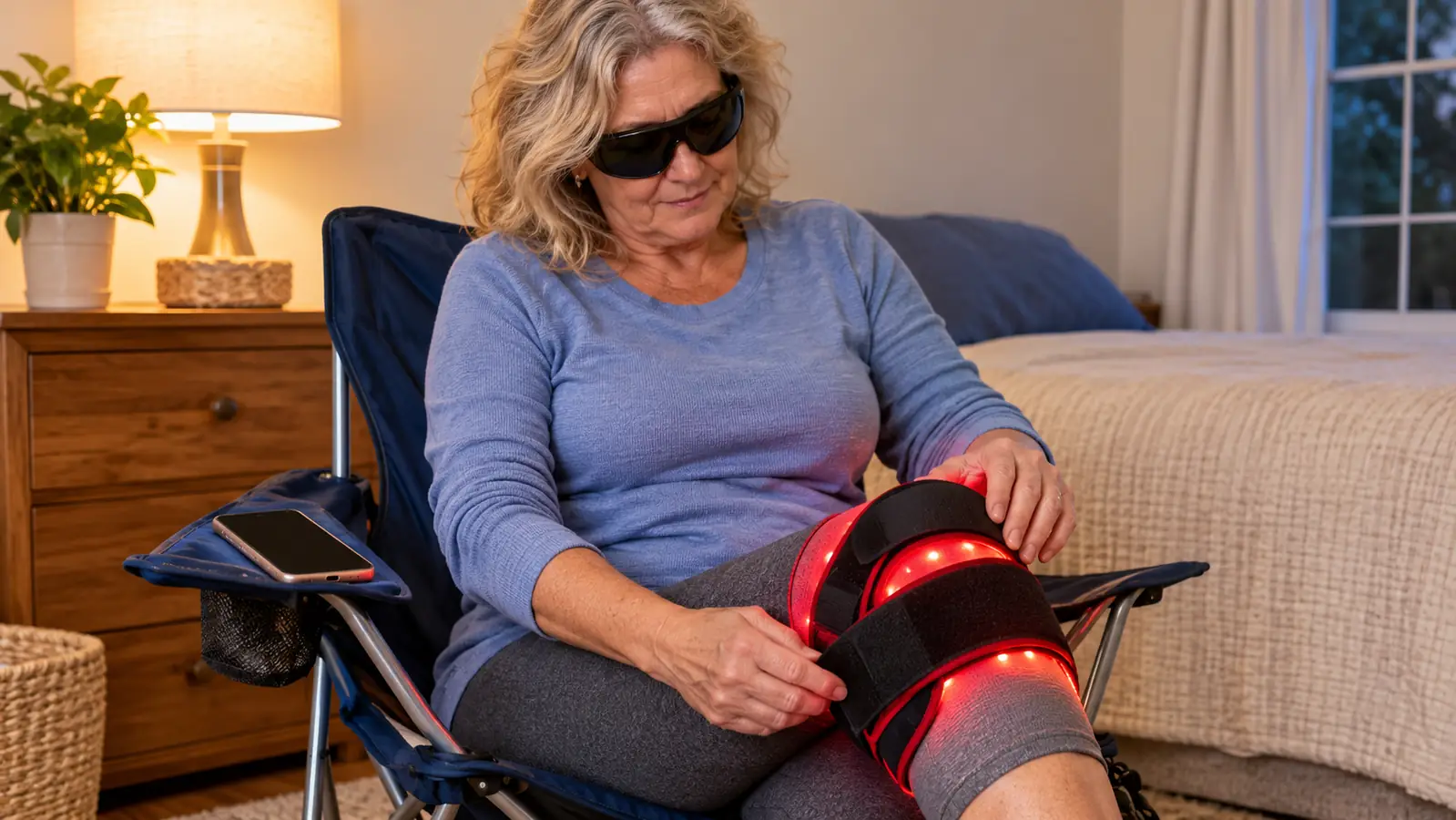
My routine is short and it is the same every time. I put on the goggles that came in the box, I press a button, I set a timer on my phone, and I sit. I wear the belt over a thin cotton shirt rather than on bare skin, mostly because I did not want to add a variable I could not account for. Eyes protected, every single time. Short sessions, most days of the week. Five or six when I am being good about it, three when the garden wins.
The first two weeks I was fussy about it. I had the belt on a schedule, I wrote the mode number on the back of an envelope, and I reset the whole thing if I lost track of where I was in the cycle. By the third week I had the sequence in my hands and the envelope went in the recycling. That is the point where a device either becomes furniture or becomes clutter, and this one became furniture.
I use it in two places. Across the knees, which is why I bought it, and around my lower back after a long afternoon of weeding. The strap reaches both without a fight and it has never slipped off mid session. I read the manual twice before the first use, which is what I do with anything that plugs in and shines light at me. It is a short manual.
What the Numbers on the Listing Actually Mean
The Comfytemp listing says 126 lamp beads. That number gets thrown around in this category and it is worth slowing down on. Each bead holds two chips, one at 660nm and one at 850nm, so every bead carries both wavelengths rather than half the belt doing one thing and half doing another. 660nm is the visible one, the wavelength people associate with skin. 850nm is near infrared, which you cannot see. If you have ever stared at a device wondering whether it was really on, that is why.
The belt draws 22 watts. Corded, as I said, which means no battery dying in eighteen months and no charging cable to lose behind a couch. The whole thing weighs 1.43 pounds. The package measures about 10 by 8 by 3 inches, so it folds down flat and lives in a drawer when we have company, which in my house means it lives in a drawer about six times a year.
The controls are four modes and three levels, changed with buttons on the belt itself. That is the entire interface. No app, no screen, no remote sitting in a drawer somewhere losing its mind. I want to be fair here: I did not understand which mode was which for the first two weeks. The manual explains it, and the buttons themselves are not labeled with anything a beginner would recognize at a glance. I sorted it out. I sorted it out slowly.
Two things I want to head off, because I went looking for them myself. There is no timer on the belt. You supply your own, and mine is the phone. And there is no sensor, no readout, no feedback loop telling you anything. It is a light that turns on when you press a button and turns off when you press it again. Some people will find that refreshing. Some people will find it thin for the money.
What Surprised Me, in a Good Way
The first surprise was how easy it is to keep using. Devices fail in my house for one of two reasons: they are a nuisance to set up, or they are a nuisance to clean up. This belt has neither problem. It hangs on a chair, I sit down, I press a button, my phone counts down, I get up. Nothing to assemble, nothing to wash, nothing to soak.
The second surprise was the build. The Comfytemp belt is not a floppy heating pad with lights stuck to the front of it. The panels are stitched, the edges are bound, and after four months of being draped over a chair and folded into a drawer it still looks like it did the day it came out of the box. Dan borrowed it twice. He is wider across the back than I am and the strap held on both of us without a fight.
I ran my thumb along one seam in particular after the second month, because that is the seam that takes the weight when the belt is draped over a chair back for hours at a time. It has not opened, has not frayed, has not done the thing cheap fabric does where it goes soft and shapeless at the stress point. That sounds like a small thing to notice. When you have returned two other gadgets in a year, you notice.
The third surprise was that I stopped wishing it were rechargeable. I wanted a battery model when I was shopping, mostly because batteries sound modern. What I actually wanted was to never think about power, and a belt that plugs in and always has power does exactly that. The tradeoff is that it stays home, and I have decided I am fine with that.
The fourth surprise, and the one that matters most to me, is that I have not stopped. I own a shelf of things I used for two weeks. This one is still on the chair.
What I Would Change
The cord. I know I just defended it, and I stand by that, but it does mean this is not a travel device. If you want to take it to a relative's house for a week, you need to be near an outlet and you need to remember to pack it. A battery version would solve that and would also be heavier and need charging, so I understand why the belt is built the way it is. I would still pay for the choice.
The buttons. Four modes and three levels, and every button is the same size and the same shape. In a dim room, with my glasses on the nightstand, I cannot tell them apart by touch. I have pressed the wrong one more than once and had to cycle all the way back around. Raised markings, or a different shape for the mode button, would fix it and would cost almost nothing to add.
No timer on the belt. My phone works and I use my phone, but I would rather set it on the device and forget it. I have walked away mid session, gotten distracted by a phone call, and come back to find the belt still going. That is my fault. It would still be nice not to have the option to make that mistake.
The strap is fine on knees and fine on a shoulder. On a wider back it takes a bit of tugging to get the panels flat against you. Nothing has fallen off, and no session has been ruined by it, but I do check the fit once before I sit down, and I did not expect to have to. Dan noticed it too, on the one evening he used it on his shoulder and then handed it back and asked whether it was meant to sit that way. It was. It just needed a second pass with the strap.
What I Liked
- 126 lamp beads, each one carrying a 660nm chip and an 850nm chip
- Corded, so there is no battery to charge and none to wear out
- Four modes and three levels, all changed by buttons on the belt
- 1.43 pounds, folds flat, stores in a drawer
- Stitched panels that still look new after four months of nightly use
Where It Falls Short
- The cord means it stays home
- Unlabeled buttons that feel identical in a dim room
- No timer on the belt, so you supply your own
- Four modes is more choice than I actually use
Nothing about this belt is dramatic. It is 1.43 pounds of stitched panels with 126 beads inside, and the reason I keep using it is that it asks me for ten minutes and nothing else.
Things Nobody Tells You Before You Buy
Nobody tells you that consistency is the whole product. Every write up about every red light device spends its words on the device. The device is the easy part. The hard part is sitting in a chair six evenings a week for months, when there is no visible sign that anything is happening, and deciding on a Tuesday in week three that you are going to keep going anyway. If you will not do that, the belt will not do it for you.
Nobody can tell you what to expect, because nobody can. I am not going to sit here and tell you this belt did anything medical for my knees. I am not a doctor and I have no way to measure it. What I can tell you is what my routine looks like, how it fits into my week, and how the belt has held up. Anything past that is somebody selling you something.
Nobody tells you to talk to your doctor first, so I will. Have that conversation before you start, especially if you take medications that make your skin sensitive to light, if you are pregnant, or if you have a history of skin cancer. My dermatologist cleared it for me, and that is the only reason I was comfortable starting at all. Photosensitivity is not a small thing, and a product listing is not where you are going to learn about it.
Nobody tells you that a belt is not a spa. A spa is an hour away from your house, a person, a robe, and a reason to leave. The belt is ten minutes in a spare bedroom while the neighbor's dog barks at a squirrel. If you are buying it to replace the hour away, it will not. If you are buying it because you are never going to drive to the spa three times a week, it might. I worked out what a weekly appointment would have cost me in driving alone, and that number settled the argument faster than any review could.
And nobody tells you how much of this is just having a chair. I am serious. The single biggest factor in whether I use the belt is that there is a chair in front of it and the outlet is behind the table. Set yours up somewhere you already sit. If you have to build a ritual around it, the ritual will collapse.
Who This Is For
This is for someone who has already decided they want a red light device and who wants one that is simple, corded, and easy to keep using at home. If you have an outlet near a comfortable chair and ten quiet minutes in the evening, the belt fits that life. It also works for a couple, since the strap adjusts enough for both of us and Dan borrowing it twice did not do any damage.
It is also a reasonable gift for a parent or a retiree who would never buy it for themselves. The Comfytemp listing says as much about office workers and seniors, and I rolled my eyes at that line, and then I thought about my own mother and stopped rolling my eyes. If the person you are buying for is practical and a little suspicious of gadgets, this one asks very little of them. And if they are the type to leave the manual in the box, tell them the short version out loud: goggles on, one button, ten minutes, done.
Who Should Skip It
Skip it if you need to use it away from an outlet. Skip it if you want an app that logs your sessions, because there is no app and no logging. Skip it if unlabeled buttons on a device will bother you every single time, because there are four modes and three levels and nothing on the panel spells out what any of them are.
And skip it if you have not talked to a doctor about light therapy in your particular situation. I mean that plainly. Photosensitivity, certain medications, pregnancy, a history of skin cancer. Those are all reasons to have the conversation before you spend anything. No belt is worth skipping it.
The belt that is still on the chair four months later
126 lamp beads with a 660nm and an 850nm chip in each, 22 watts, corded, four modes and three levels. If you want the version that plugs in and never needs charging, this is the one I use.
Amazon Check Today's Price on Amazon →