
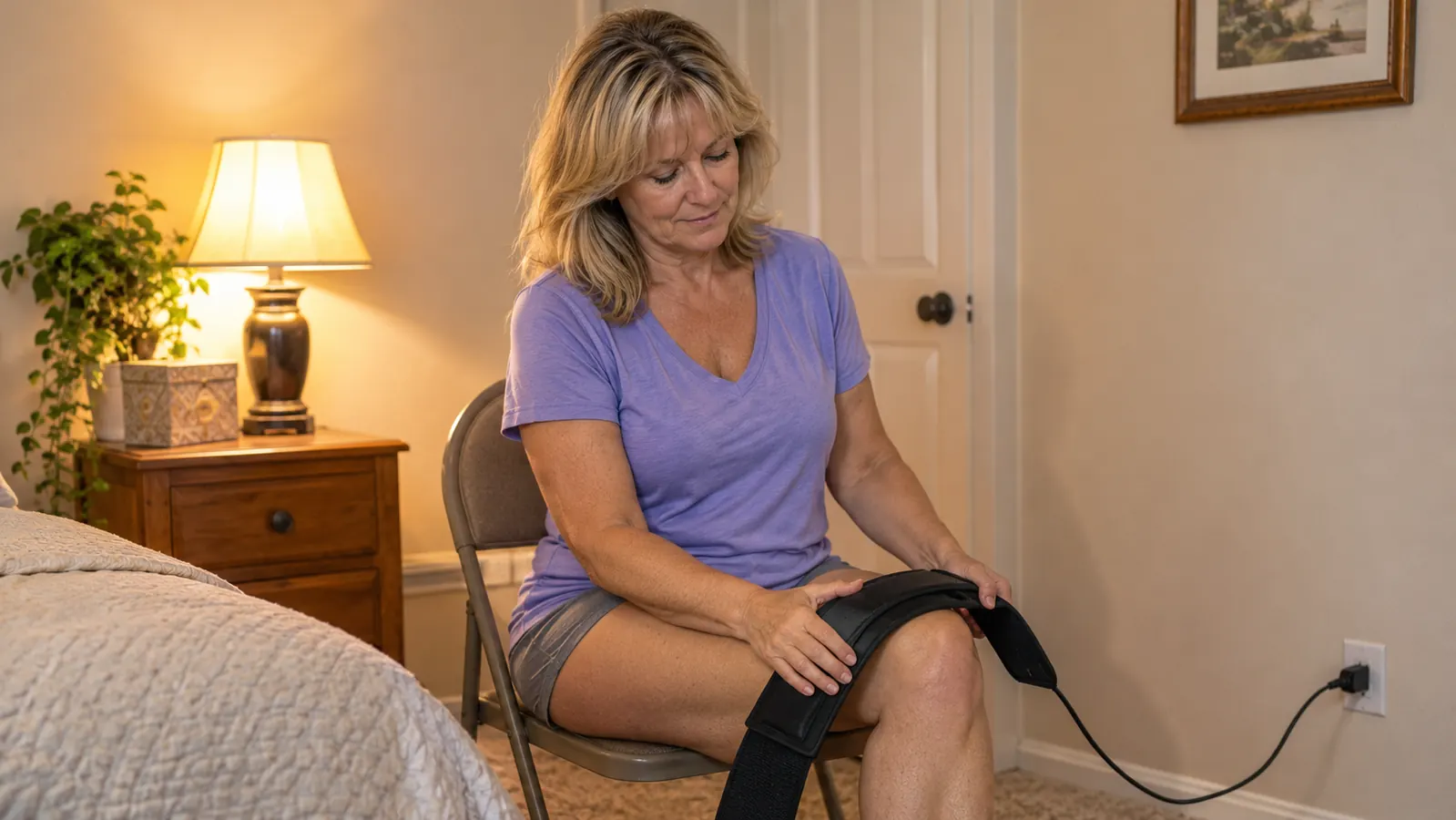
I am Paula Westerkamp, 57, a retired dental hygienist in Boise, Idaho. I bought the Comfytemp Red Light Belt with 126 LEDs after my knees started complaining on the Boise foothills trails. I am not a doctor, and this is not medical advice. I am one person with one spare bedroom, a folding table by the closet, and a husband named Dan who borrows things now and then. I use the belt in the evening, most days of the week, and I time sessions on my phone. Before I bought it, I looked at the other red light options: A full-body panel, a handheld wand, and a small desk unit. The Comfytemp belt was the one that fit my actual life. That is the whole reason I am writing this.
Here is the short answer. A full-body panel is the better choice if you want to stand in front of a broad light for a whole-body routine. The Comfytemp belt is the better choice if your main complaint is one or two specific spots, like a knee, a lower back, or a shoulder, and you want to keep the light close without rearranging a room. They are not the same tool. One wraps around you. One stands across the room. I compared them on setup, coverage, controls, and how often I actually used them. The last one mattered most. A device you skip is not helping you, no matter what the box says. I checked with my dermatologist before I started, and I would tell you to check with yours, especially if you have photosensitivity, take medication that makes you light sensitive, are pregnant, or have a history of skin cancer.
| Comfytemp belt | Full-body panel | |
|---|---|---|
| Form | A corded belt with 126 LEDs that wraps a knee, lower back, or shoulder | A rigid panel on a stand or door mount, used from a short distance |
| Coverage in one session | One joint or a small area at a time | A larger area such as the whole back or both legs at once |
| Light placement | Sits against the area, so the LEDs stay close to the skin | You stand or sit at a set distance from the panel |
| Setup | Plug in, wrap it, press the buttons on the belt | Assemble or position the panel, then find your distance |
| Hands free | Stays in place while you read or answer email | You stay in front of it; moving away ends the session |
| Controls | 4 modes and 3 levels, buttons on the belt | Controls vary by model and may sit on the unit |
| Whole-body routine | Not built for a full-body session | Built for standing in front of it for a broader skin routine |
| Storage | Folds into a drawer or suitcase and packs small | Panel and stand take up floor or door space |
| Best for | Knees, lower back, one shoulder at a time | A broader area or a full-body routine |
What the 126 LEDs and 4 Modes Mean in Practice
The Comfytemp belt has 126 lamp beads. Each bead contains two chips, one at 660nm and one at 850nm. I am not going to pretend I can feel the difference between two wavelengths. What I can tell you is that the belt is bright enough that I wear eye protection during a session. I keep it in the drawer with the belt. The belt is corded and rated at 22 watts. That is not a number I think about during a session. It is a number I thought about when I looked at the outlet by the closet and made sure I had a free spot. I put my folding chair near that outlet so the cord reaches without a strain. If your chair is far from an outlet, measure that before you buy.
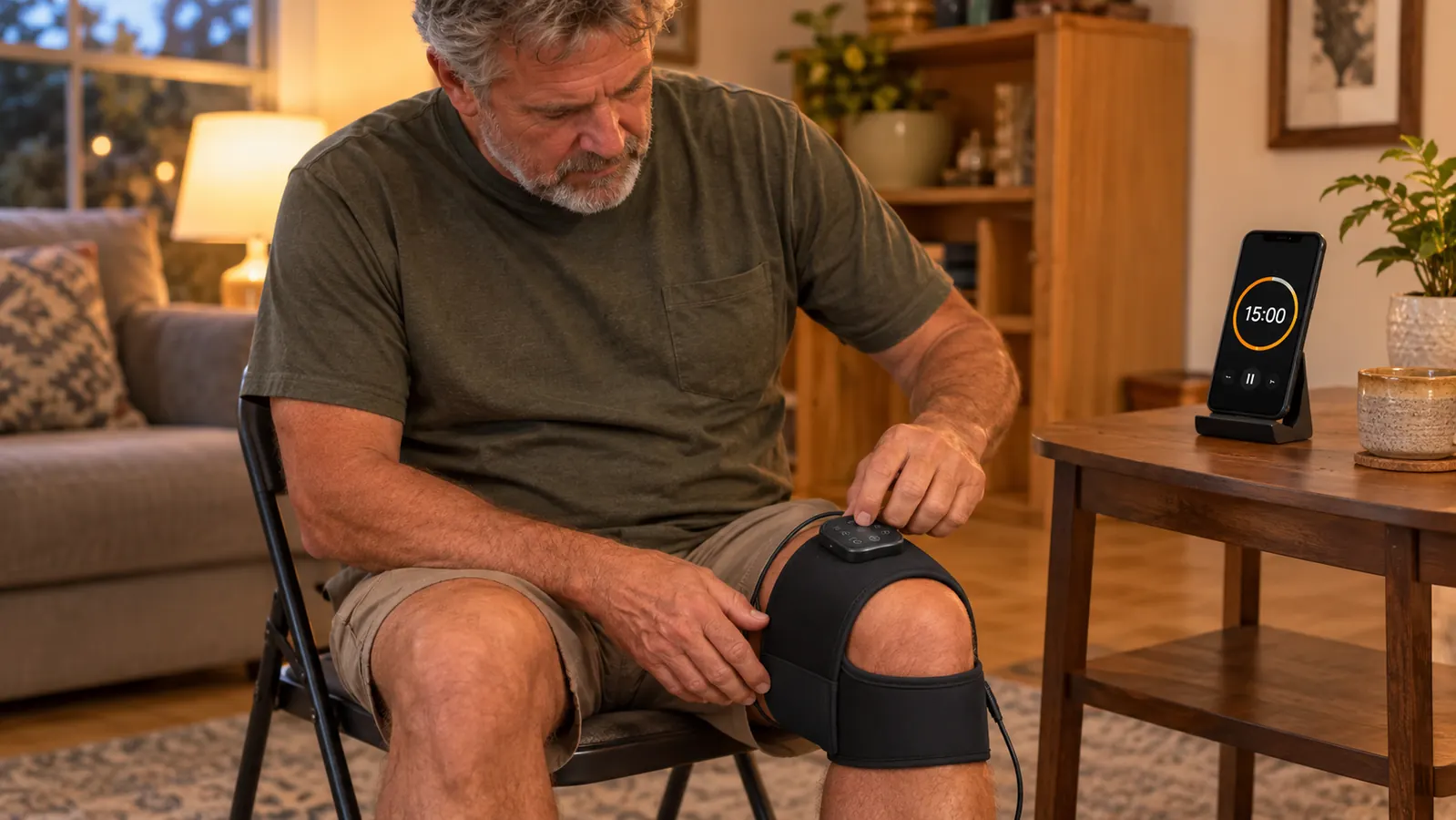
The controls are simple. There are 4 modes and 3 levels, and the buttons are on the belt. I did not need a manual to turn it on, but I read the manual twice anyway. That is who I am. I found one mode and one level that felt right for me and I stopped changing it. The other modes are there if you want to experiment. The 3 levels are useful because the top level is not the one I want on a bare knee. I started low and stayed low. I set my phone for the session length. That is fine with me. I already have a phone, and I already have a timer. I do not need another screen in my life.
I also want to be clear about what the belt is not. It is not a full-body panel. It does not cover your whole back and both legs at once. It does not stand on a floor stand or hang on a door. It is a belt. You wrap it. You sit down. You keep it on one area. That is the job. If you want a broad routine, the belt will feel like work because you have to move it. If you want a spot routine, the belt feels easy because you do not. That is the trade in plain language. The rest is details.
The belt did not ask me to rearrange the spare room. I plugged it in, wrapped it around my knee, and set my phone. That is why I use it.
The Corded Part Is the Tradeoff
The belt is corded. I plug it into the wall. That means I do not have to think about charging it, and I do not have to wonder whether it will quit halfway through a session. It also means I am tethered to the outlet. I cannot walk to the kitchen with it on. I cannot take it in the car. I sit in the folding chair, or I sit on the edge of the bed if the cord reaches. For my routine, that is fine. I use it in one place, at one time, in the evening. The cord is part of the reason the belt is simple. There is no battery to manage.
If you want to move around while you use a red light device, the belt is not the right choice. A panel is also not the right choice if it is a plug-in panel, but a panel stays in one place by design. The belt is the same. It is a sit-down tool. I would rather tell you that now than have you buy it and be annoyed. I use the outlet by the closet, I keep the cord out of the walkway, and I unplug it when I am done. That is my routine. It takes ten seconds. I do not think about it anymore. After a session, my knees felt warm and looser. That is my experience, not a promise. I did not take a before and after photo. I did not measure my range of motion. I noticed that I stopped skipping the session because the setup was already done. That is the honest version.
Where Comfytemp Wins
The Comfytemp belt wins on contact and convenience. The 126 LEDs sit on a belt that wraps around the area. I do not have to hold anything or sit at a measured distance. I plug it in, wrap it around my right knee, press the buttons on the belt, and set my phone. The cord is part of the deal. It is a corded belt, 22 watts, and I use the outlet by the closet. That means no charging routine and no hunting for a battery. It also means I am not walking around the house with it. I sit down. I read. I answer email. The session ends when my phone alarm says so. I like that the controls are on the belt. I do not have to get up to change a mode or a level. The belt has 4 modes and 3 levels. I found one mode and one level I liked and stopped fiddling. That is not a small thing for a device I use most evenings.
The other place the belt wins is targeting. The light is close to the skin because the belt sits against the area. For a knee, that matters. For a lower back, it matters. For a shoulder, it matters. A panel is designed for a broader area, and you position your body in front of it. If I want light on the front of my knee and the back of my knee, I can wrap the belt and shift it. I cannot do that with a panel unless I turn around. The belt also stores in a drawer. The box is 10.08 by 8.35 by 2.68 inches and weighs 1.43 pounds. I have packed it in a suitcase for a weekend trip. I would not do that with a panel and stand. The whole setup lives in one small space, which is why I actually use it.
Where a Full-Body Panel Wins
A full-body panel wins on coverage. That is not a small thing. If your goal is a broader skin routine, the panel is built for standing in front of it and letting the light reach a larger area. The Comfytemp belt covers one joint or a small area at a time. I would not pretend otherwise. If I wanted to cover my whole back, both legs, and my chest in one session, the belt would be the wrong tool. I would be moving it around and resetting it. The panel does that job in one pass. That is a real advantage, and it is why people buy panels in the first place. A panel can also be used at a set distance, so the light lands across a wider area instead of concentrating on one spot. If your routine is about skin on your face, neck, chest, and arms, the panel is the more natural fit.
The panel also wins on even distance across a large area. With a belt, the light is close, but the area is small. With a panel, you stand at a set distance and the light covers more skin at once. For a face and neck routine, or for a whole-back routine, that is the point of the panel. I still use the belt more, because my knees are the reason I started. But I am not going to tell you the belt is better for everything. It is not. If you want a broad routine, buy the tool built for a broad routine. If you want a targeted session on a knee, buy the belt. The panel also takes up floor space or door space. That is the trade. You get coverage, and you give up the drawer. In my spare bedroom, the drawer wins. In a bigger room with a dedicated spot, the panel could win.
If your knees are the reason you are here, start with the belt that wraps them.
The Comfytemp belt puts 126 LEDs, 4 modes, and 3 levels on a corded belt you can strap on and forget. It is the tool I reach for on ordinary weeknights, not a special occasion.
Amazon See the Comfytemp Belt on Amazon →Who Should Buy Which
Buy the Comfytemp belt if you want a targeted session on a knee, a lower back, a shoulder, or a hip. Buy it if you live in a small house and do not want a panel and stand in your spare bedroom. Buy it if you like a simple routine: plug it in, wrap it, press the buttons on the belt, set a phone timer, and sit down. Buy it if you want something that folds into a drawer and packs in a suitcase. Buy it if you are like me and you know yourself well enough to admit that a device with more setup will get skipped. The belt is not a full-body solution. It is a spot solution. For my knees, that is what I needed. Dan has borrowed it for his shoulder twice, and he gave it back both times, which is its own kind of review.
Buy a full-body panel instead if your goal is a broader skin routine and you have a spot to leave it set up. Buy it if you want to cover your whole back, both legs, or your chest in one session. Buy it if you are comfortable standing at a set distance and you do not mind the space it takes. Buy it if you want the light across a larger area and you are not mainly chasing one knee. I am not against panels. I looked at them. I would have bought one if my goal had been whole-body sessions. My goal was my knees after a hike, and the belt fit that goal better. That is the whole comparison in one sentence. Check with your doctor or dermatologist before you start either one, and use eye protection.
One knee, one drawer, one routine that actually happens.
Comfytemp is the belt I plug in on a weeknight when my knees are stiff from the foothills. It is corded, it has 126 LEDs, 4 modes, and 3 levels, and it stores in a drawer. If that matches your life, it is worth a look.
Amazon Check the Comfytemp Belt on Amazon →