
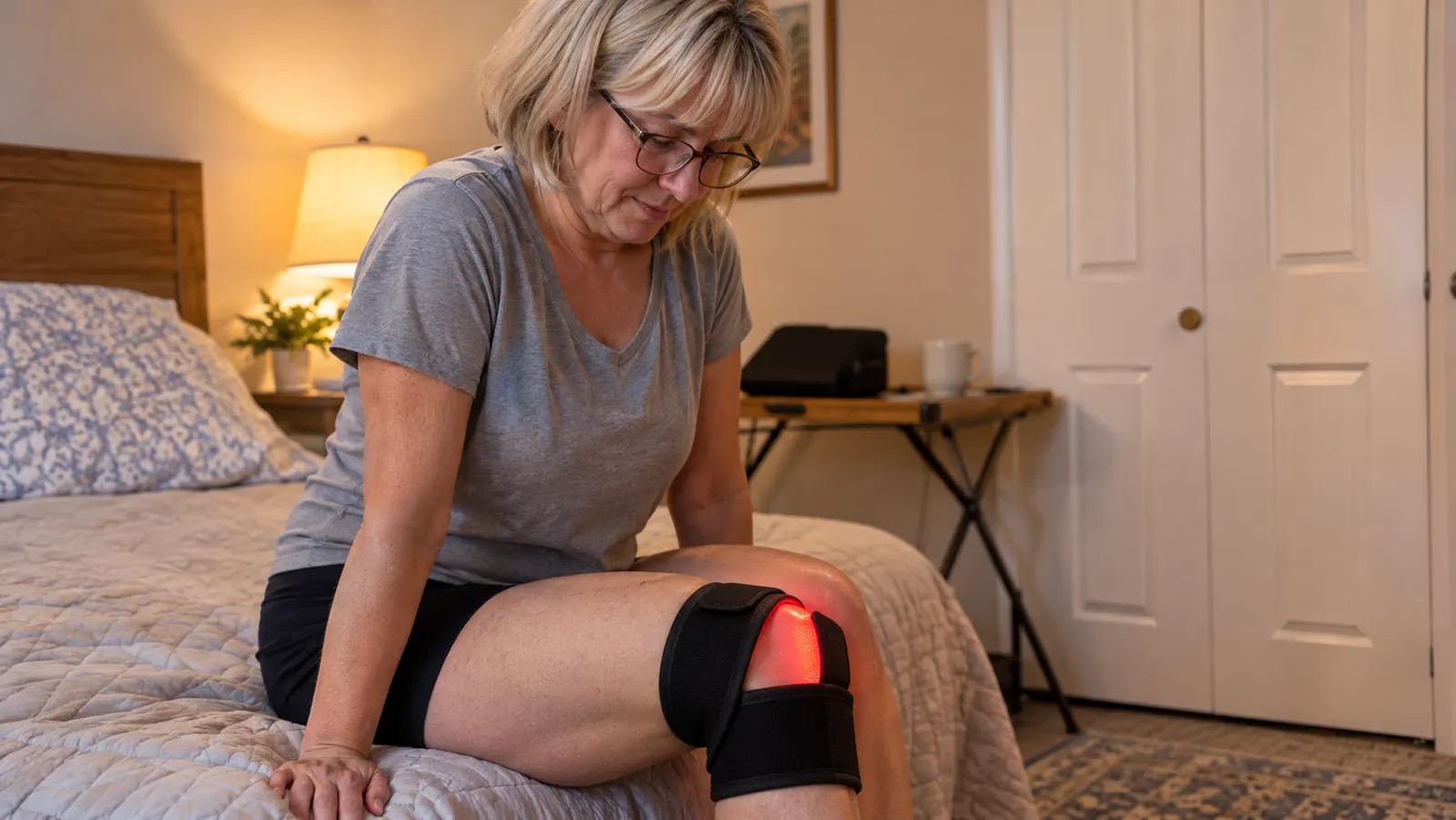
I bought the Comfytemp red light belt in February, after a winter of pretending my knees were fine. They were not fine. I am 57, retired from dental hygiene after 31 years of leaning over people's mouths, and my husband Dan and I hike the Boise foothills most Saturdays when the weather cooperates. By January, the downhill half of those hikes had turned into a negotiation. I did not want a pill. I did not want a brace that made me look like I was recovering from surgery. I wanted something I could use for ten minutes in the evening and then forget about.
That is roughly how I ended up with a corded light belt on my closet folding table. I read the manual twice, which is a habit I picked up in a profession where the difference between two products is often one line in the instructions. I am not a doctor and I am not going to pretend this is medicine. My dermatologist said it was fine to try, I cleared it with my primary care doctor at my annual visit, and everything below is one woman's experience in one spare bedroom in Idaho. Wellness use only. Not medical advice.
The Quick Verdict
An honest corded panel belt with real wavelength specs and a generous bead count. The cord and the button placement are the tradeoffs you are accepting.
Amazon Check Today's Price →The belt I kept plugging in after the novelty wore off
126 beads, two chips each, 660nm and 850nm, four modes and three levels. Corded, so the output never fades on you mid-session.
Amazon Check Today's Price on Amazon →How I've Used It
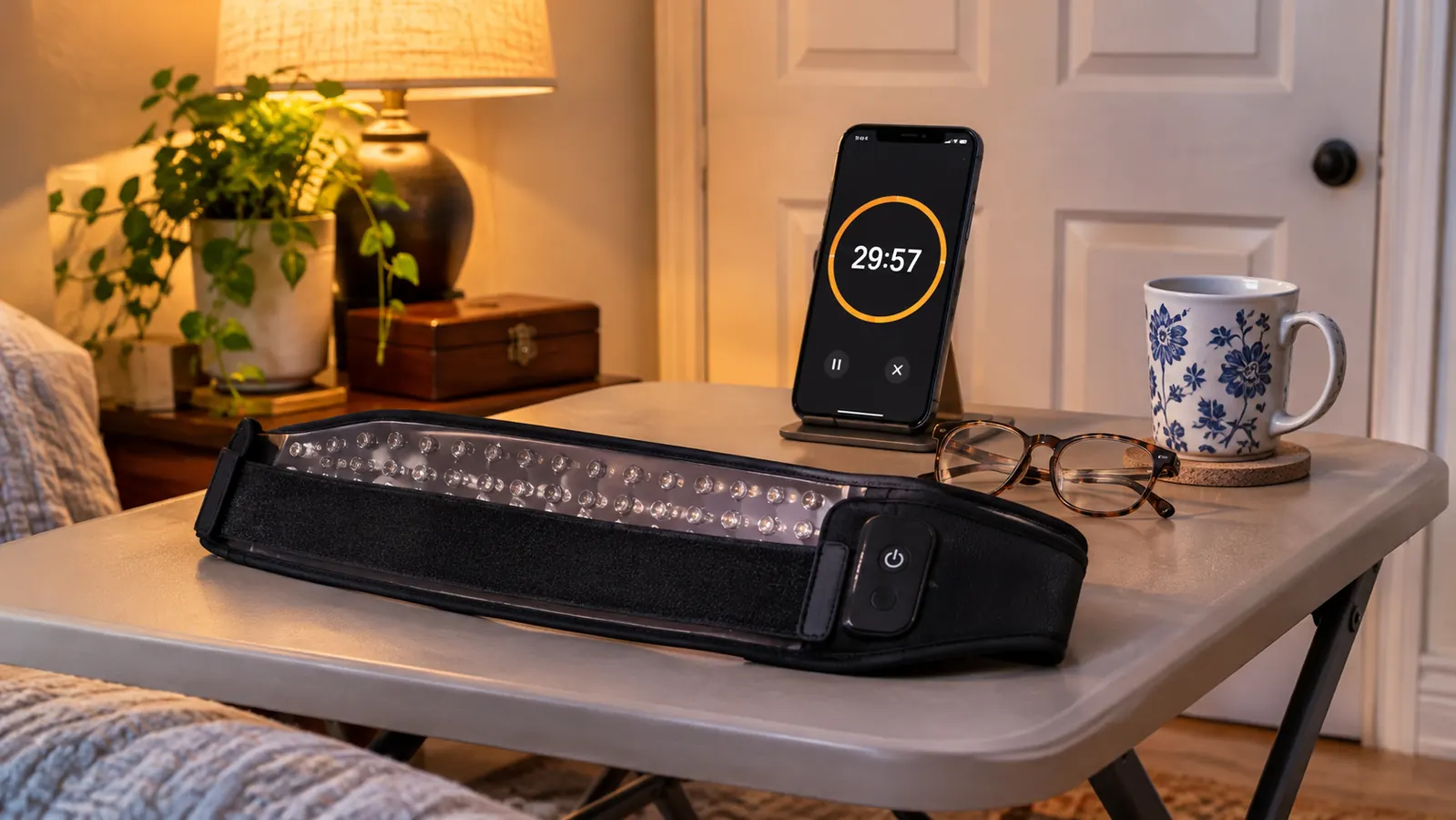
The setup is the least interesting part, which is exactly why it works for me. The belt lives on the folding table by the closet in our spare bedroom, next to a power strip and a pair of reading glasses. I plug it in, wrap it where I want it, press the buttons, and start a timer on my phone. Ten minutes on the left knee. Ten on the right. Some weeks I skip the knees entirely and do my lower back, depending on what the week has been like.
Before this I tried two other things. The first was a microwaveable gel pack I heated in the kitchen and carried upstairs, which was pleasant for about two weeks and then the trip down the hall started to outweigh the reward. The second was a drugstore compression sleeve that squeezed my knee hard enough that I lasted three days. Both had a problem the Comfytemp belt does not. They asked something of me before I could begin. The gel pack wanted the microwave, a timer and a walk. The sleeve wanted a fight. The belt wants a plug and ten minutes I was going to spend sitting down anyway.
The first session I did not feel much of anything. There was a faint warmth through the belt and that was it. I remember thinking, well, that was twenty minutes and a shrug. But I kept at it, because the alternative was doing nothing, and doing nothing had already gotten me a winter of stiff mornings. By the end of the second week I had stopped dreading the ten minutes, which for me is the real test of any routine.
Most days I use it in the evening, after dinner, before Dan turns on whatever sport is in season. He has borrowed it twice for his shoulder. He lasted about four minutes both times and then wanted to know why it did not have a battery. That is a fair question and I will get to it.
What 126 Beads and Two Wavelengths Actually Mean
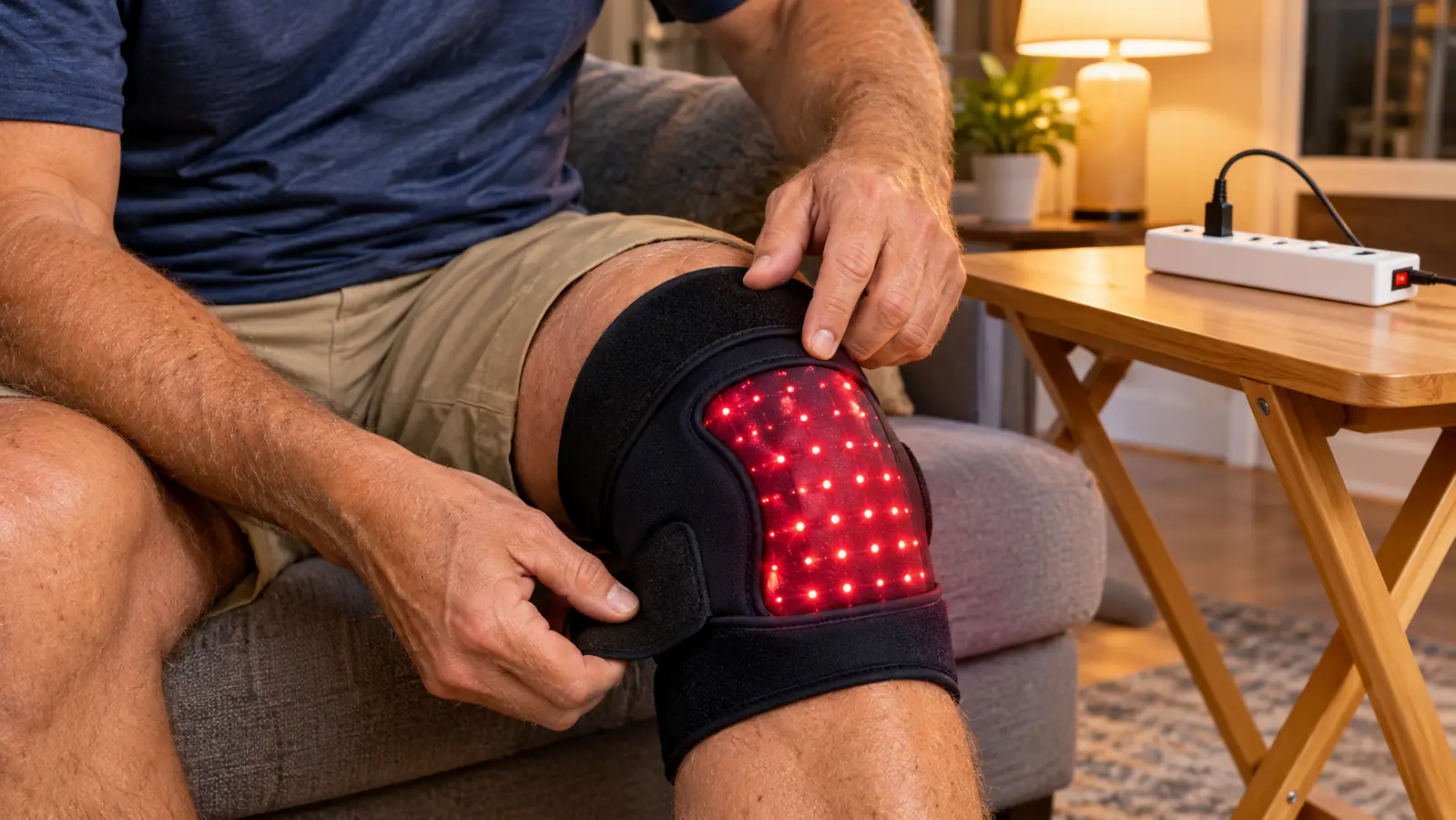
Here is the part I actually checked, because the marketing on light devices is a swamp. The Comfytemp belt carries 126 lamp beads, and each bead holds two chips. One chip runs at 660 nanometers, which is the visible red. The other runs at 850 nanometers, which is near infrared and sits just past what your eye registers. So when the belt is on, you are getting both at once, not one or the other.
Why that matters to me is simple. A lot of inexpensive belts advertise a wavelength count and then quietly ship a single chip. Two chips per bead, at those two specific numbers, is the thing I wanted to confirm before I trusted the rest of the listing. The unit draws 22 watts. That is a small number and it is honest about it. Nobody is claiming a stadium floodlight here.
The box arrived at 1.43 pounds and measured 10.08 by 8.35 by 2.68 inches, which is about the size of a hardback novel. I mention that because I had a picture in my head of something bulky that would need its own drawer. It folds onto the shelf beside my reading glasses instead. There is no heavy control box to set down, no separate pack to charge, no second cord to untangle. Everything is stitched into the belt itself, which sounds like a small thing until you have spent a winter stepping over a charging cable in the dark.
I also want to be straight about what I can and cannot tell you. I cannot tell you what happens at the cellular level, and anyone who says they can is selling something harder than a belt. I can tell you that what I feel through the belt is warmth, and that the visible red is what makes the session feel like something is happening even when my knees are being quiet about it.
The Four Modes and Three Levels, and How I Settled On One
The belt runs on buttons built into the belt itself. Four modes, three levels. The manual lays them out, I read it twice as promised, and then I did what most people do, which is press things until something feels right.
I landed on a middle level for the knees and the lowest level for anything close to bare skin on my lower back. The higher levels are warmer. That is the honest summary. If you are the kind of person who wants a dial with numbers on it and a chart telling you which setting to use for which body part, this is not that device. You get four modes, three levels, and your own judgment.
The buttons being on the belt is the one design decision I would argue with. If the belt is wrapped around your knee and you are already sitting down, reaching the controls means twisting or unwrapping. I learned to set everything before I settled in. Dan, who will not read a manual, learned it the hard way.
Six Weeks In: What I Noticed and What I Did Not
I am going to be careful here, because this is where reviews in this category usually lose the plot. I am not going to tell you the belt fixed my knees. What I will tell you is that six weeks of ten-minute evening sessions became a habit I did not hate, and that the walks I took in March felt different from the walks I took in January. Whether that was the belt, the stretching I started at the same time, or the fact that February ended, I genuinely do not know. I changed two things at once, which is not good science and is very normal life.
One Saturday in March is the marker I use. Dan and I did the Table Rock trail, about three and a half miles round trip and uphill most of the way. In January I had stopped halfway, sat on a rock, and let him go on without me, which I did not enjoy admitting afterwards. In March I went up and came back down without stopping, at a pace that is not fast but is mine. I did not do anything different that week. Same ten minutes in the evening, same middle level, same phone timer propped against the mug. I am not handing the belt credit for the whole thing. But it sat on that table, plugged in, all winter, and I used it because it was there and because it cost me nothing but the sitting.
What I did not get: I did not get a dramatic before and after. My skin did not transform. My knees still creak going down the stairs at the library. The difference is smaller and duller than the listing photos suggest, and I suspect that is true of nearly everything in this category.
What surprised me was how much I looked forward to the ten minutes. It is warm, it is quiet, and it is the only part of my day where I sit still without a phone in my hand, aside from the timer. I have started calling it my evening pause, which Dan finds funny.
The Cord, the Fit, and the Small Annoyances
The belt is corded. There is no battery. I want to be blunt about that, because the listing title says it and people still miss it. You need an outlet within reach, and if you want to use it on the couch you need an extension cord. The upside is that it never dies mid-session and it never gets weaker as a charge drops. The downside is that you are tethered, and after six weeks I still notice it.
It is not shaped like a knee brace and it does not have a hinge or a cinch strap, so you wrap it around whatever you are working on and let it sit. On the knee, that is one wrap and a tuck. On the lower back, I wrap it around my waist and lean back against the chair so the panel stays flat. On the shoulder, I needed Dan for the first week and then worked out that I could pin it with my elbow long enough to press the buttons. The manual does not prescribe a position, and after six weeks I would say the belt rewards five minutes of trial and error more than it rewards reading.
In all three places it stayed where I put it, which is more than I can say for the heating pad it replaced. I do not fiddle with it mid-session, and that is the whole test.
The other small thing: I could not find a timer anywhere on the belt, so you supply your own. I use my phone, ten minutes, and the phone face down on the table has become part of the ritual. If you are the type to forget and walk away, set the timer before you start. That is not a knock on the device, it is just how it works, and I would rather you know it now than find out on a Tuesday night.
What I'd Tell a Friend Before She Buys
Talk to your doctor first. I mean it, and not as a paragraph I paste at the bottom because a website told me to. I have a friend on a medication that makes her skin sensitive to light, and this is not something she should be experimenting with on her own. Same for anyone who is pregnant, anyone with a history of skin cancer, and anyone taking something that lists photosensitivity as a side effect. My dermatologist cleared it for me. Yours may not clear it for you, and that is useful information too.
Second thing: decide whether corded is fine before you order. If your favorite chair is nowhere near an outlet, this will be a nuisance and you will use it less. If you have a table and a power strip, you will use it most nights, which is the entire point.
Third: give it a few weeks before you decide. Two sessions told me nothing. Six weeks told me something.
What I Liked
- 126 beads with two chips each at 660nm and 850nm, which is more honest than most specs in this category
- Corded, so the output does not fade the way a battery does
- Four modes and three levels, all set with buttons on the belt
- Stays where you wrap it, on a knee, a lower back, or a shoulder
- Simple enough that I actually kept the habit for six straight weeks
Where It Falls Short
- Corded means tethered to an outlet, and to an extension cord in most rooms
- The buttons sit on the belt, so reaching them means twisting or unwrapping
- No built-in timer that I could find, you supply your own
- The higher levels run warm enough that I would not use them against bare skin
- The change is subtle and slow, which is not what the listing photos promise
Two sessions told me nothing. Six weeks told me something, and what it told me was quieter than the listing promised.
Who This Is For
This is for the person who wants a simple, repeatable ten minutes in the evening and does not want to build a protocol around it. If you are stiff after the activities you love, if you are past fifty and tired of adding one more thing to the day, and if you have an outlet near the chair where you actually sit, the Comfytemp belt fits into a life without rearranging it.
It is also a reasonable first step for someone who has been curious about red light and does not want to start with a full panel. The belt format is forgiving. You can use it on a knee, a back, or a shoulder, and you do not have to clear wall space or move furniture to do it.
Who Should Skip It
Skip it if you need it to be cordless. That is the single biggest reason people will bounce off this, and no amount of liking the light output fixes a belt that is tied to the wall by your nightstand.
Skip it if you want a device that tells you what to do. There is no program, no app, no schedule, and nothing automatic. Four modes, three levels, your judgment. Skip it if you are not going to talk to a doctor first, especially if you have any photosensitivity concerns. And skip it if you need dramatic, fast, visible change, because that is not what I got, and I would rather tell you that now than have you find out in March.
Ten minutes, my phone timer, and an outlet by the closet
126 beads at 660nm and 850nm, four modes, three levels, 22 watts on a cord. It is the one piece of kit I did not have to talk myself into using.
Amazon Check Today's Price on Amazon →