

The first time I wrapped the Viconor belt around my neck I was sitting on the edge of the bed in our spare bedroom in Boise with a timer running on my phone, feeling a little foolish. I am 57, retired after thirty years as a dental hygienist, and my neck spent most of those years bent forward over somebody else's teeth. I bought the belt because I wanted something small I could use for ten minutes at the end of the evening, not because I expected anything dramatic. What I did not expect was how clearly it would compare against the rigid red light panel a neighbor lent me for a month.
Here is the short answer. They are not the same tool, and they are not really competing for the same ten minutes. The Viconor belt is a soft wearable wrap with a timer built into it. You strap it over one spot, the neck or a knee or a wrist, and it stays there while you do something else. The rigid tabletop panel is closer to furniture. It sits on a stand, it wants a wall outlet, and you sit in front of it. One comes to the spot that is bothering you. The other asks you to come to it.
| Viconor neck belt | Rigid tabletop panel | |
|---|---|---|
| Form | Soft belt that wraps or drapes over one spot | Rigid panel on a stand |
| Hands free | Yes, it stays on while you sit or lie down | No, you sit still in front of it |
| Coverage in one session | One area at a time, neck or knee or wrist | Broad area, both shoulders and upper back together |
| Timer | Built into the belt | Varies by model, some expect you to time it yourself |
| Power | Runs off a power bank, so no cord back to the wall | Plugs into the wall and stays put |
| Storage | Folds into a drawer | Lives on its stand |
| Eye protection | Worth wearing, the light sits close to your face | Still worth wearing, though you are further away |
| Best for | One specific stiff spot, ten minutes at a time | A longer session across a wider area |
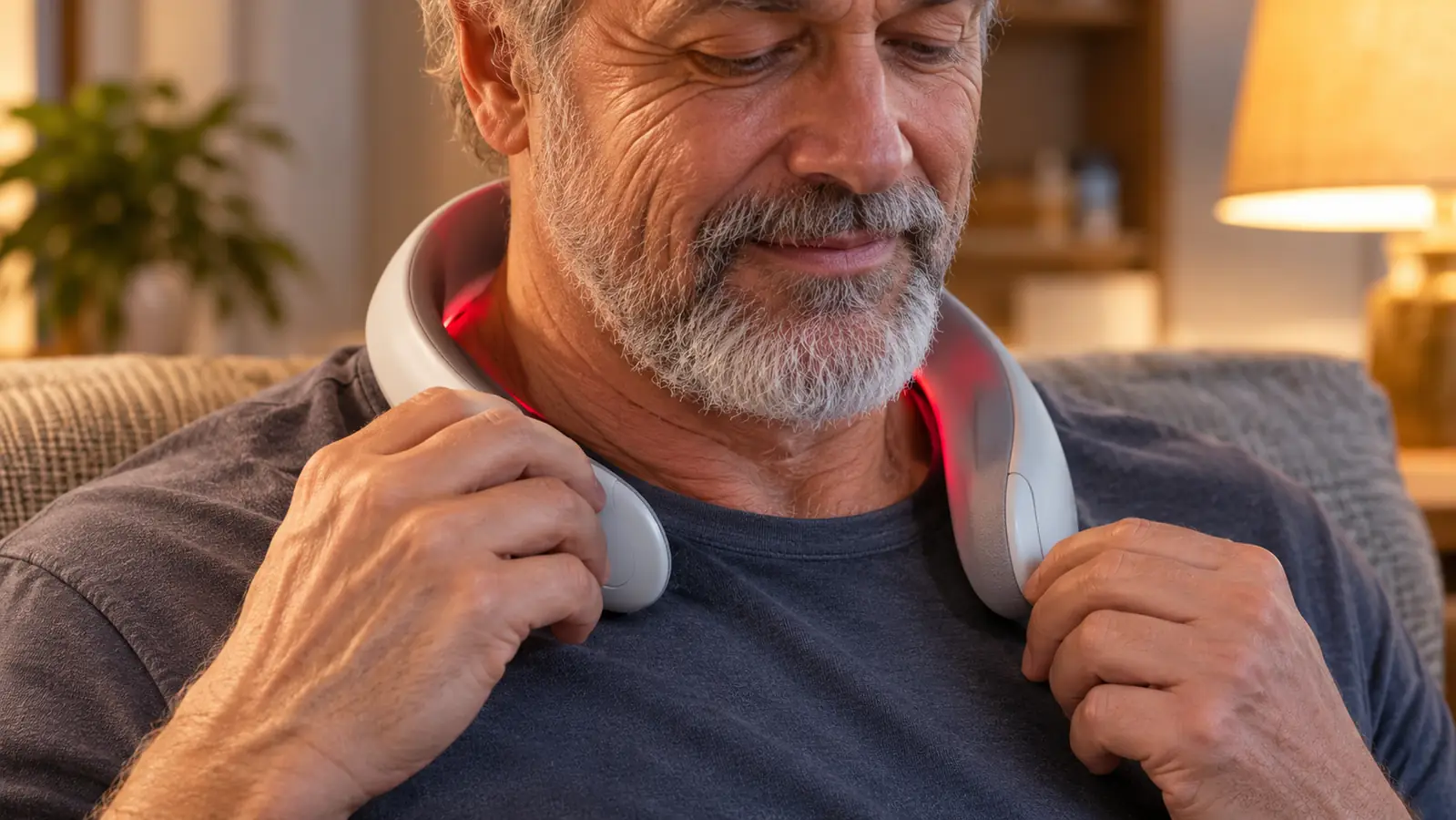
The first difference shows up in your hands. With the belt on, both of them are free. I have sat through an entire cooking show, folded a load of towels, and answered a few emails with the wrap around my neck and the timer counting down. With the panel I found myself sitting still and doing nothing, which sounds restful and is, for about four minutes. After that I was checking the clock. If you already struggle to sit still for ten minutes, that matters more than anything printed on a listing page.
The second difference is where the light actually lands. A panel lights a broad area. My neighbor's unit covered my whole upper back and both shoulders at once. The belt does one region, but it does it against the body, wrapped around the joint instead of shining across a room at it. The practical effect for me was that the panel felt like a session and the belt felt like a habit. Ten minutes with a wrap around my neck on a Tuesday is easy. Ten minutes sitting in front of a panel in the spare room took scheduling.
The panel felt like a session. The belt felt like a habit, and the habit is the part that lasted.
How I Ended Up Comparing Them at All
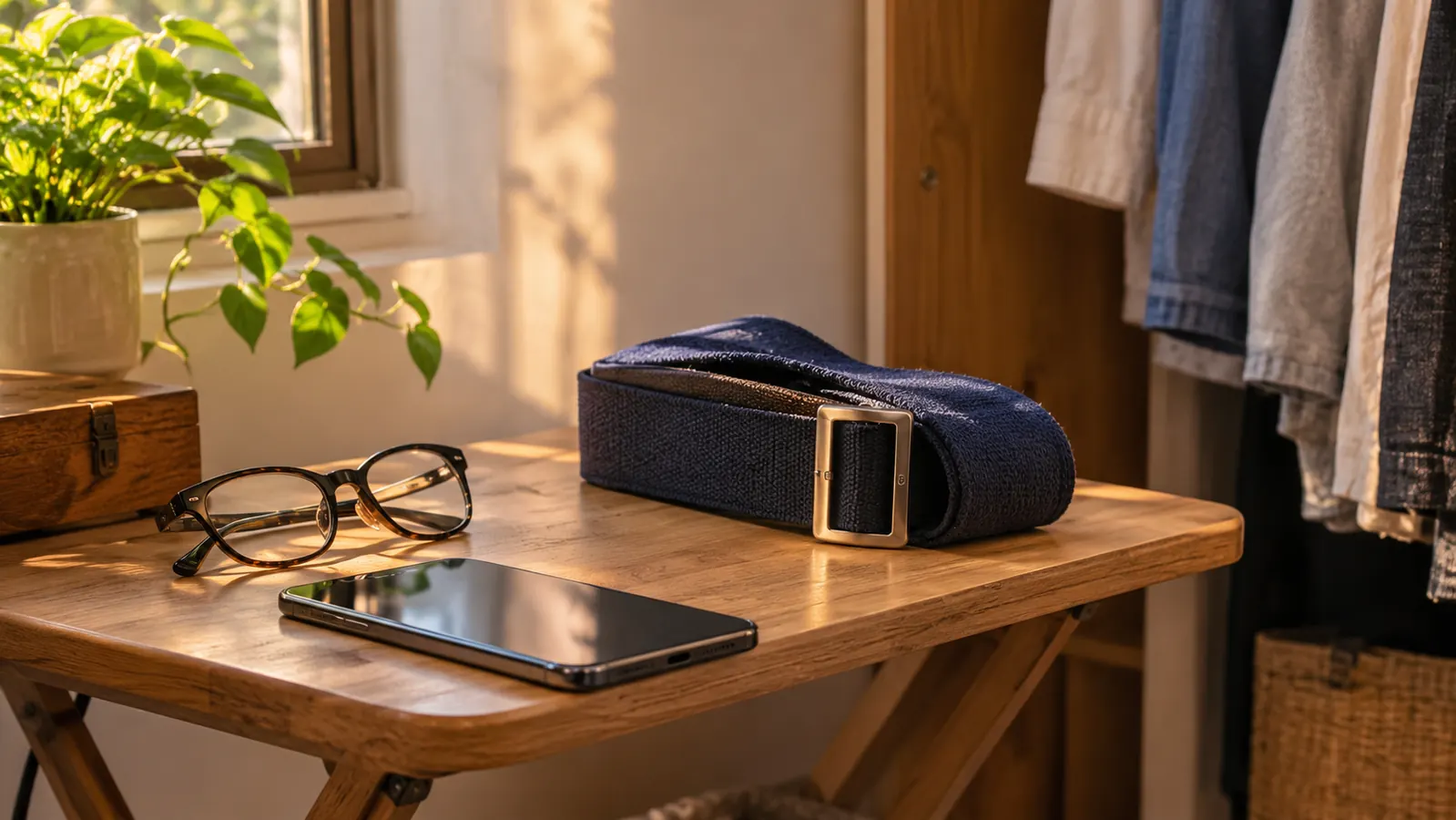
I did not set out to compare anything. I bought the belt first, in the spring, after my dermatologist said it was fine for me to try red light at home as long as I protected my eyes and stopped if anything looked irritated. Then a neighbor offered to lend me her panel for a month because she had stopped using it. I set it on the folding table in our spare bedroom, the same table where I keep the belt, and for four weeks I used the panel on some evenings and the belt on the others. That is not a laboratory. It is one woman in one house with a stiff neck and a stiff knee, and it was enough to notice which one I reached for.
My setup has not changed since. Folding table by the closet, a power bank for the belt, my phone as a timer, and eye protection. I keep my eyes covered whether I am using the belt or the panel, because the light from a wearable sits close to your face and I do not want to be careless about it. Dan, my husband, borrows whichever one is out on the table. He is 60 and has a shoulder that complains after an afternoon in the yard. He has no patience for the panel. He likes the belt because he can keep watching television.
What Differs in Daily Use
Setup is the first thing. The panel is not hard to use, but it has a place and a cord and it stays in that place. Getting it out means clearing the table first. The belt lives in a drawer and takes up about as much room as a folded sweater. That difference sounds trivial until you are deciding at nine at night whether to bother. I bothered with the belt far more often.
The strap took me two evenings to work out. The first night I had it too loose and it slid. The second night I overcorrected and it was snug enough to be distracting. By the third night I had it set and it has been a five second job ever since. That is the part of a wearable nobody mentions. The fitting is the learning curve, not the light. I will say the panel had its own version of that, since I had to work out how far back to sit before it felt like anything.
The other difference is what you can combine it with. The belt is hands free, so it stacks onto things I was going to do anyway. Reading, listening to a podcast, sitting with my feet up. The panel needs me present and facing it, which makes it its own appointment in the evening. Neither of those is a flaw exactly. They are two shapes of the same ten minutes, and one shape fits my week much better than the other.
What the Listings Do Not Tell You
One thing the product page answered and my first week confirmed. The belt is meant for more than a neck. The listing names neck, leg, arm, ankle, hand, feet, joint and chin, and that matches what I found, because a soft strap does not care much which limb it happens to be around. It is also built to run off a power bank, which is why there is no cord dragging across the floor to the wall outlet at my house. I did not think I would care about that. I care about it every night when I get up to turn off the lamp.
The other thing I noticed is how little the extras mattered. I did not need a stand or a schedule built around a piece of furniture. I needed something I could put on and then forget about until the timer let me know the time was up. That is a small thing to learn about yourself at my age, but it changed how I think about buying anything for the house. The one you will actually use beats the one with the longer feature list, every time.
What I Liked
- Timer is built into the belt, so nothing else to set
- Both hands stay free while it is on
- One strap works on a neck, knee, wrist, ankle or hand
- Runs off a power bank, with no cord back to the wall
- Folds flat into a drawer between sessions
Where It Falls Short
- One area at a time, so a wide session takes several placements
- The strap takes a couple of evenings to get adjusted right
- The light sits close to your eyes, so eye protection matters
- It is not a substitute for anything a doctor recommends
Where the Viconor Belt Wins
Where the belt wins is fit and follow through. It wraps around the joint instead of lighting it from a distance, so a neck, a wrist, an ankle or a knee all work with the same strap. The timer is built in, which means I am not setting a phone alarm every evening and then forgetting to cancel it. It runs off a power bank, so there is no cord across the floor and nothing to trip over in the dark once I am finished.
It also wins on the parts of my body I actually complain about. My knees are the reason I started paying attention to any of this. They stiffened up after a couple of seasons hiking the Boise foothills, and a wrap that bends around a knee and stays put is a different experience from a panel that wants the knee held in front of it for ten minutes. I will not tell you either one fixed my knees. I will tell you the belt is the one I can use while sitting on the couch with my leg propped on a cushion.
Where a Rigid Tabletop Panel Wins
The panel wins coverage, and it is not close. In one session it lit my whole upper back, both shoulders and the back of my neck at the same time. If your complaint is broad, wide and spread across a large area, a panel is the sensible tool for it. The belt would take three separate placements to cover the same territory, and by the third placement I would be bored and finished.
It wins on power too, in a boring way that matters. It plugs into the wall and it is always ready. There is no power bank to remember to charge and no cable to hunt for in a drawer. The belt being compatible with a power bank is exactly what makes it portable, but a charged battery is still one more object I have to think about. If remembering to charge one more thing is the difference between a routine that lasts and one that quietly stops, the panel is the friendlier choice.
Two Things I Would Check Before You Buy
First, decide what spot you are actually trying to look after. If it is one area, roughly the size of your two hands, a wrap makes sense. If it is a wide band across your shoulders or your whole back, a panel makes sense and a wrap will frustrate you. Write it down honestly. The temptation is always to buy for the body you wish you had rather than the one with the stiff joint in it.
Second, talk to your doctor or dermatologist before you start either one. I did, and I would say it plainly to anyone sitting at my kitchen table. Photosensitivity, some medications, pregnancy and a history of skin cancer are all reasons a professional should weigh in first. I use red light as part of an ordinary evening routine and I am not making a medical claim about it. What I have is a ten minute habit that I enjoy and that fits my week. That is all it is.
If the stiff spot is your neck, start with the one you can wear
A soft wrap with a timer built in, a strap you set once, and a power bank you probably already own. Ten minutes, most evenings. Wellness use only, and worth a conversation with your doctor first.
Amazon Check Today's Price on Amazon →Who Should Buy Which
Buy the Viconor if your complaint is specific and small. A neck that stiffens at a desk. A knee that complains after a hike. A wrist, an ankle, a hand. Buy it if you know yourself well enough to admit you will not schedule a session but you will wear something while you watch television. Buy it if you want the option of taking it to a hotel or to a friend's house without packing a stand and a cord.
Buy the panel instead if your problem is wide, if you want both shoulders covered at once, or if you are the sort of person who genuinely enjoys sitting still in a chair facing a light for ten minutes. It is also the better pick if you want one device you plug in and never think about charging again. Some people will get more out of the panel. I did not, and I think it is worth saying so plainly rather than pretending one shape of device suits every body.
One wrap, one charger, ten minutes, then it goes back in the drawer
The one I reach for on a Tuesday night. Hands free, timer included, no cord to the wall.
Amazon Check Today's Price on Amazon →