
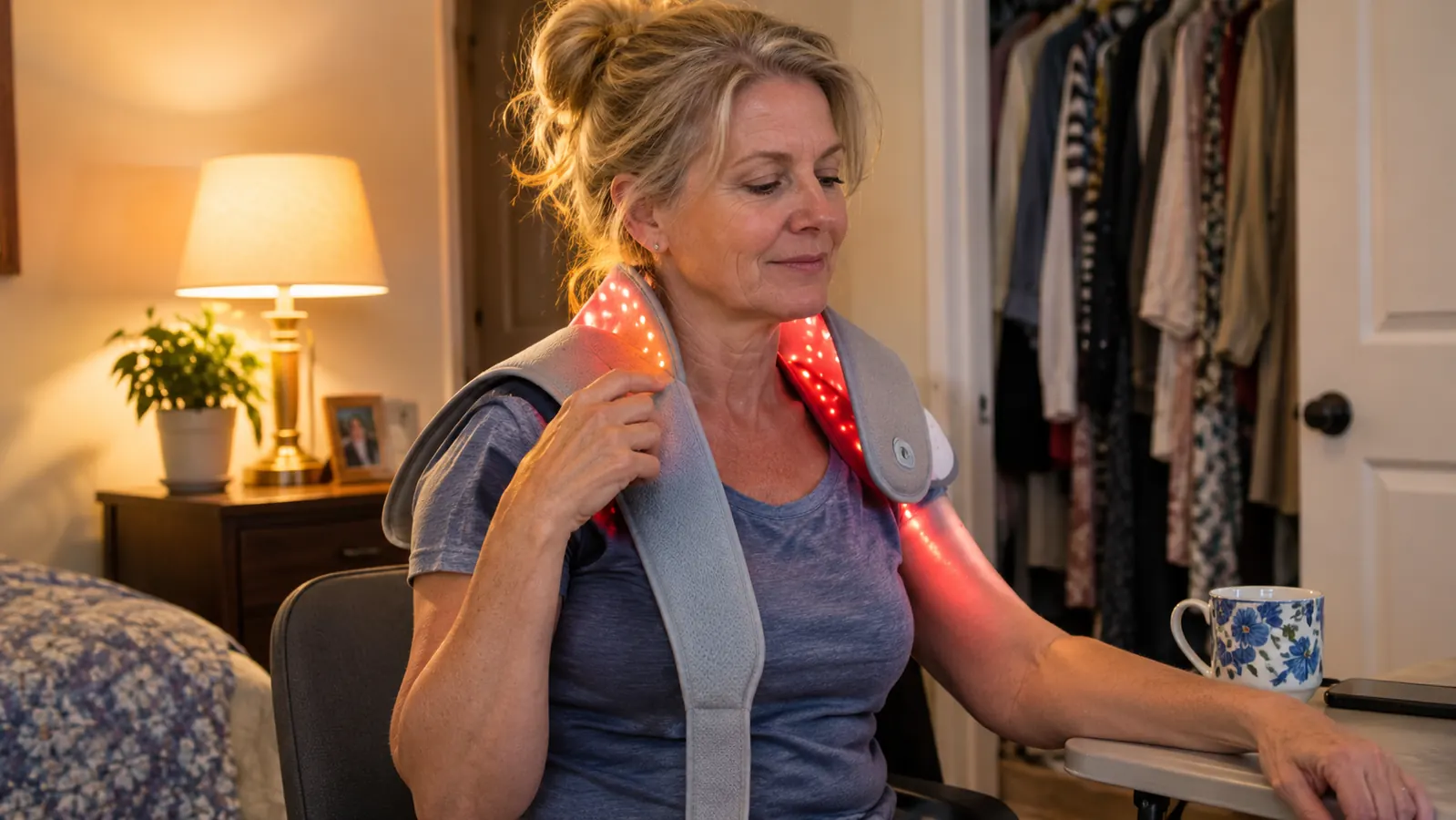
Hiking season in the Boise foothills ends for me around the last week of October, and every year it ends the same way. I come home from the final long trail with a neck that feels like it belongs to somebody else. I am 57, retired after thirty-one years as a dental hygienist, and leaning over patients for three decades left my neck with opinions. This year the opinions were loud enough that I finally went looking at the red light devices everyone keeps mentioning.
I want to be clear about who is writing this. I am not a gadget person. I read the manual twice before I plug anything in, and I made my husband Dan sit with me the first time I turned the Viconor belt on, mostly so there would be a witness if it did something strange. I also asked my dermatologist at my annual skin check whether a red light device at home was a reasonable thing for me to try. She said it was fine. She also told me to keep up with my regular checks, and I am passing that along.

The Viconor red light therapy belt is a flexible band that wraps over the neck and shoulders. It has a strap that holds it where you put it, it has a timer, and it runs off a power bank. That last detail is what sold me. I set the battery pack on the folding table in the spare bedroom, plug the belt in, and I am not tethered to a wall outlet by the closet. The box came with goggles, and I wear them every single time. Looking into near infrared by accident is not on my list of things to do at 57.
My routine is boring, which is how I know it will stick. After dinner, around seven, I go into the spare bedroom, sit in the chair by the closet, drape the belt over my neck and shoulders, set the timer, put the goggles on, and let it run while I listen to a podcast. Short sessions, most days of the week. I do not wear it while walking around the house or cooking. The belt is hands free, but I am not interested in multitasking with something that is shining light at my chin.
Around week three I noticed I had stopped rubbing the back of my neck during the evening news, which is a thing I had been doing since roughly 2019.
If hiking season left your neck stiffer than it used to be, this is the belt I bought
The Viconor neck belt, the power bank, and the goggles all came in one box. Start with shorter sessions than you think you need, and set the timer.
Amazon Check Today's Price on Amazon →I am not going to tell you what this belt will do for you. The listing mentions pain relief and skin, and I am one person in a spare bedroom with a podcast, not a study. What I can tell you is what six weeks of short evening sessions felt like for me. The first two weeks, nothing. I almost quit, and I told Dan I had wasted the money, which is a sentence I say about most things I buy. Around week three I noticed the thing in the pull quote above. By week six I could sit through an entire movie without shifting around in the chair.

There is also the chin and jaw area. I am 57. My jawline has been quietly heading south since my forties, and if I drape the Viconor belt high, it covers that area too. I cannot measure whether anything changed there and I am not going to pretend I can. What I can say is that the routine made me pay attention to my neck and jaw in a way I had not in years, and at my age, paying attention is most of the battle.
Dan borrowed it twice. He is 60, his shoulder complains when he hauls the recycling bin to the curb, and he sat in my chair with the belt on and the timer running and said it was warm and pleasant. That is the review he gives everything, including my meatloaf. He has not asked for it since, so it lives on the folding table by the closet where I can find it without thinking.
Two things I would change. The strap takes a little fussing to get right the first few times, and I had to read the manual twice before I trusted the timer. Also, the belt wants a power bank, so plan for that if you do not already own one. It is not a device you switch on and forget about. It is a device you set up once, learn, and then it becomes part of the evening the way flossing did when I was still working.
What I'd Tell You If We Were Sitting at My Kitchen Table
I would tell you to talk to your doctor or dermatologist before you buy. Not because something went wrong for me, but because light is not neutral for everybody. If you take a medication that makes you sensitive to light, if you are pregnant, or if you have a history of skin cancer in your family, ask first. Mine took five minutes of an appointment I was already having. I would also tell you to start with shorter sessions than you think you need, to wear the goggles every single time and not just the first time, and to give it longer than two weeks before you decide. I nearly quit at day twelve.
Six weeks, short sessions, and a timer. That was the whole routine.
If you are going to try this, buy the belt, read the manual twice, and put it somewhere you will actually see it every evening. That is the part that made the difference for me.
Amazon Check Today's Price on Amazon →